
Welcome offer: 10% off on your first order with code "SVAMART10" X
Craft & Culture

The Living Material of Indian Craft

By Satyam Dubey 5 Views Mar 02, 2026
The Living Material of Indian Craft

In India, wood has never been just a material. It has been structure, shelter, sculpture, ritual and routine. Before steel grids and engineered boards became dominant, lakdi was the backbone of everyday life from carved temple doors to kitchen tools, from toys to intricate furniture. To understand wood craft in India is not merely to study technique. It is to understand a civilizational relationship with a living material. Unlike synthetic substitutes, wood carries organic memory. It grows. It ages. It responds to climate. Even after being shaped by human hands, it continues to breathe subtly within its environment.

This biological quality changes how we perceive it. Wood feels warm. It absorbs sound. It softens space. Psychologically, humans respond differently to natural materials. Research in environmental psychology suggests that organic textures reduce stress and create a sense of grounding. Hum mehsoos karte hain ki wood “alive” hai even if we cannot articulate why. Metal feels cold. Plastic feels neutral. Wood feels personal. This perception has economic implications.

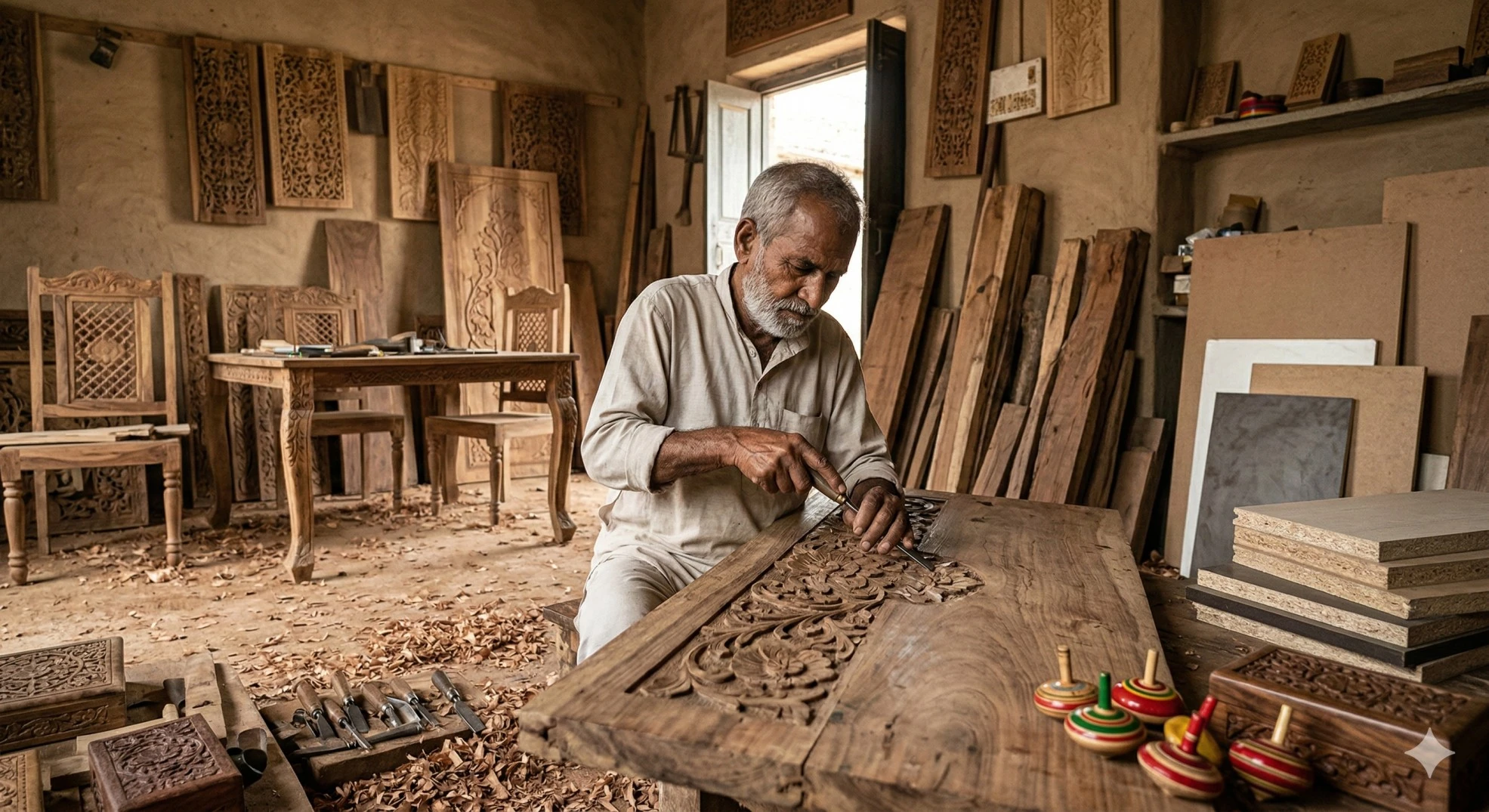
Traditional Indian woodcraft evolved in clusters where skill was passed across generations. In Saharanpur, artisans developed intricate carving techniques on sheesham and mango wood, producing detailed panels and furniture. In Channapatna, turned and lacquered wooden toys combined geometry with vibrant color. In Kashmir, walnut wood carving became synonymous with refined floral detailing. Each region adapted to available timber, climate and cultural aesthetics.

These clusters were not isolated artistic pockets. They were local economies. Woodcraft supported families, trained apprentices and created distributed production networks long before the term “circular economy” became fashionable.The shift began with industrialization and later accelerated with modular housing and engineered materials. Plywood, MDF and composite boards reduced cost, standardized production and shortened manufacturing time. From a purely economic perspective, this transition made sense. It allowed faster urban expansion and affordability for a growing middle class But speed has consequences. Engineered boards optimize efficiency; they compress production cycles. Solid wood craftsmanship, in contrast, operates on time. It requires seasoning, carving, finishing and patience. Jahan machine minutes me cut kar deti hai, artisan ghanton me shape deta hai.

In markets driven by rapid consumption, time-intensive production becomes financially vulnerable. Consumers compare prices without comparing processes. A carved wooden table is evaluated against a machine-laminated alternative, despite entirely different cost structures. The result is not immediate extinction of craft, but gradual marginalization. Younger generations in artisan families often shift toward more stable employment because the economics of slow production struggle against fast supply chains. However, woodcraft is not obsolete. It is mispositioned.

There is renewed global interest in sustainable materials and long-lasting products. Solid wood, when responsibly sourced, offers durability that engineered substitutes often cannot match. Ek solid wood piece decades tak tik sakta hai; low-cost alternatives frequently require replacement. The long-term cost equation shifts when durability enters the calculation.

The challenge is integration, not preservation in isolation. Woodcraft cannot survive solely as “heritage.” It must adapt to contemporary design sensibilities, urban space constraints and digital marketplaces. Artisans need design collaboration, market intelligence and direct-to-consumer visibility to compete structurally, not sentimentally. The conversation should not frame woodcraft as something to “save.” It should frame it as something to strategically reposition Because wood is not only a material of the past. It is a material of continuity.

When we choose wood over synthetic substitutes, we are not just selecting texture or aesthetics. We are choosing longevity over disposability. Process over speed. Depth over uniformity. Lakdi sirf vastu nahi hai. Woh samay hai , preserved in form And time, once respected, reshapes how we value everything else.


Share Now

Download application to explore more

Bringing art into lifestyle