
Your cart is empty, and it looks like you haven’t added anything yet.
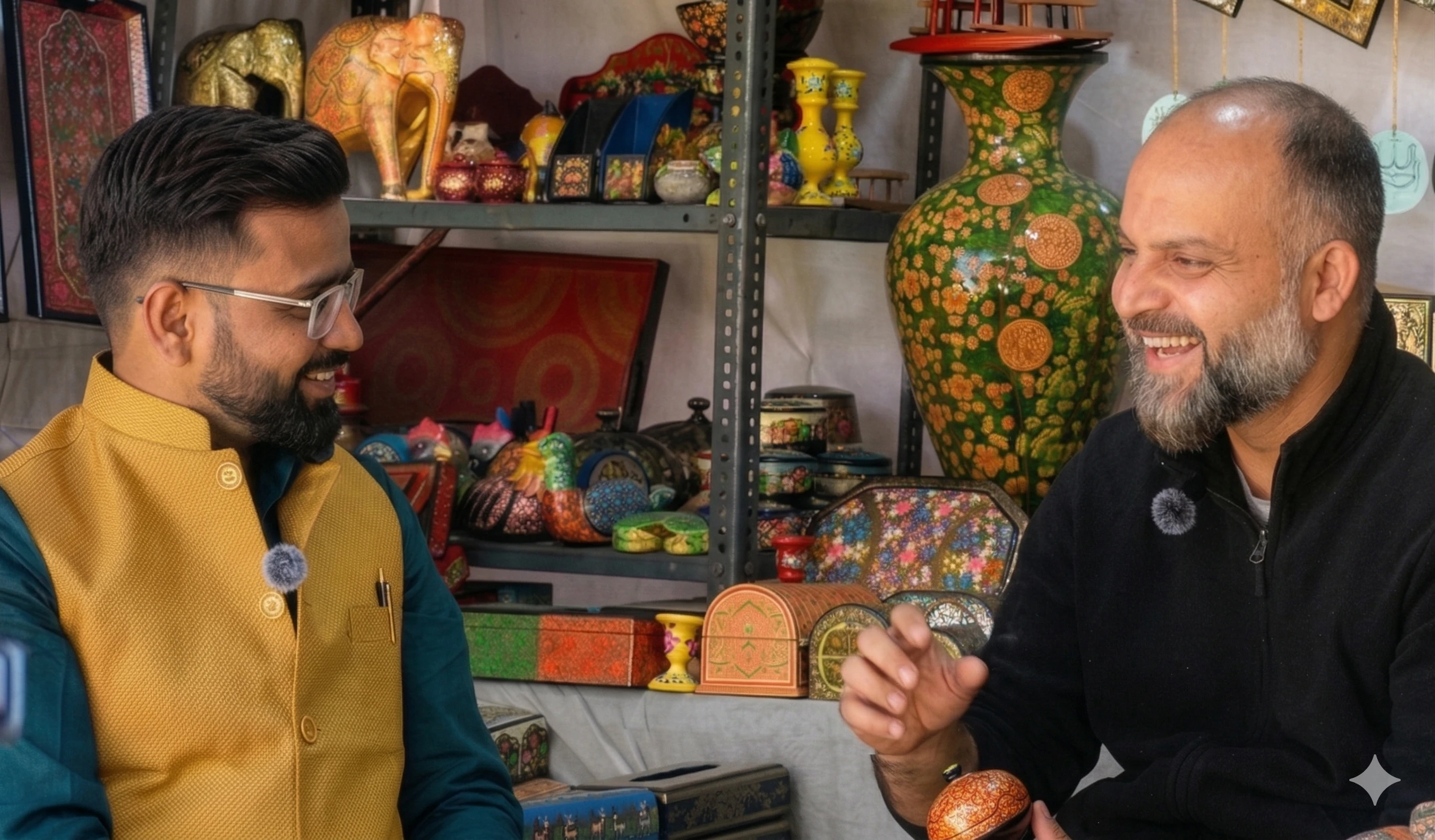
Kashmiri Paper Mâché is often admired for its intricate beauty finely painted boxes, vases and decorative objects that reflect remarkable craftsmanship. At a surface level, it appears delicate and ornamental. However, beyond its visual appeal lies a deeper system of material transformation, disciplined process and cultural continuity. Originating in Kashmir, this craft traces its roots to Persian influences that were gradually adapted by local artisans. Over generations, it evolved into a distinct artistic identity, known for its detailed floral motifs and refined handwork. What appears as a finished product is, in reality, the result of multiple carefully executed stages.
At its foundation, Paper Mâché begins with waste paper. The material itself is ordinary, inexpensive and widely available, yet through soaking, pulping, moulding and drying, it is transformed into structured forms capable of holding both durability and design. “Value does not always begin with the material; it often begins with transformation.” This shift from discarded paper to crafted object highlights a fundamental truth: value is not inherent in material alone, but is created through process, perception and effort. Yahaan material simple hai, lekin process uski pehchaan badal deta hai.
Kashmiri Paper Mâché operates within a complex market environment. Mass-produced decorative products, often visually similar, are available at lower prices due to scale efficiency. Consumers frequently compare based on appearance rather than production depth. This creates a perception gap. “Hum aksar product ko dekh kar uski keemat judge karte hain, process ko samajh kar nahi.”
When the effort behind a product remains invisible, pricing appears disproportionate. A handcrafted object may seem expensive, not because it is overpriced, but because it is being compared to a fundamentally different system of production.Machine-made products optimize cost. Handmade products embody time.
The making of Kashmiri Paper Mâché is inherently time-intensive. Each stage layering, drying, smoothing and polishing demands precision, while the final stage of naqashi, or hand-painting, defines the identity of the piece. Drying alone can take days depending on environmental conditions, and the process cannot be rushed without compromising quality. “Craft is not slow because it lacks efficiency; it is slow because it respects process.” In a market increasingly driven by speed and volume, such time-intensive practices often struggle to compete with mass-produced alternatives.
This creates a gap between process and perception. Mass-produced decorative products may appear similar at first glance, but their production systems are fundamentally different. Machine-made items benefit from scale and cost efficiency, while Paper Mâché relies on human skill and time. “Hum aksar product ko dekh kar uski keemat judge karte hain, process ko samajh kar nahi.” When effort remains invisible, pricing appears disproportionate, and handcrafted objects are often perceived as expensive without a full understanding of the work behind them.
Kashmiri Paper Mâché, therefore, should not be seen merely as decorative output. It represents a system of knowledge passed through generations, often within families, sustaining both cultural identity and livelihoods. “Cheap material does not mean cheap value; it often means value created through effort.” This distinction shifts the conversation from what a product is made of to how it is made, and why that process matters.
In a world increasingly defined by speed, uniformity and instant availability, crafts like Kashmiri Paper Mâché offer an alternative perspective. They remind us that not all value can be compressed into efficiency. Aur shayad yahi is craft ki asli strength hai yeh hume process ki value samjhata hai. The future of such crafts depends not only on preservation, but on repositioning integrating traditional skill with contemporary markets without losing depth. Because when process disappears from perception, value often disappears with it.
In a world increasingly defined by speed, uniformity and instant availability, crafts like Kashmiri Paper Mâché offer an alternative perspective. They remind us that not all value can be compressed into efficiency.
Aur shayad yahi is craft ki asli strength hai , yeh hume process ki value samjhata hai. The future of such crafts depends not only on preservation, but on repositioning integrating traditional skill with contemporary markets, without losing depth Because when process disappears from perception, value often disappears with it And sometimes, what appears simple on the surface carries the deepest layers beneath.
You need to Sign in to view this feature
This address will be removed from this list