
Your cart is empty, and it looks like you haven’t added anything yet.
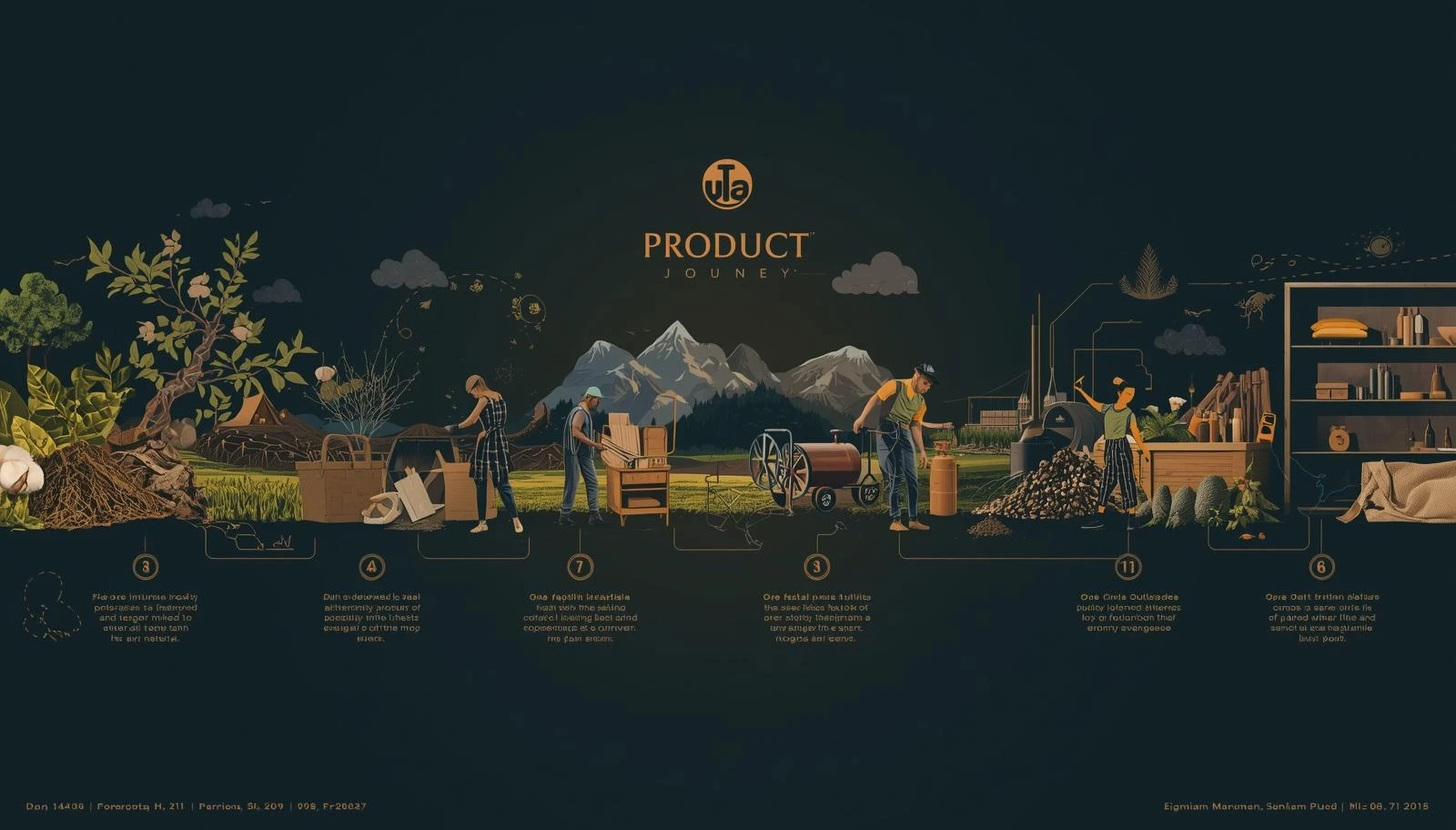
In most modern marketplaces, a product appears to us only at its final stage. It sits on a shelf, appears on an online page, or arrives in carefully designed packaging. At that moment, it seems complete defined by its price, brand and design. What often remains unseen is the journey that led to that moment. Every product begins long before it reaches the consumer. It begins with a material. Wood grows slowly in forests. Cotton develops across agricultural cycles. Metals are extracted from deep geological layers. Even before human intervention begins, nature has already invested time, energy and resources. Yet this origin is rarely part of the consumer’s view.
Every object starts as a raw material shaped by natural processes. In many traditional systems, the relationship between material and maker is direct. Artisans understand the behaviour of wood grain, the strength of natural fibres or the flexibility of certain metals. Yahaan material sirf input nahi hota, balki ek relationship hota hai. Natural materials respond differently to climate, time and handling. This sensitivity often requires patience and knowledge developed over years. The maker does not simply transform the material; the maker learns to work with it.In industrial systems, this relationship becomes more distant. Materials move through standardized processes designed for speed and consistency. The focus shifts from understanding the material to controlling it.
Once material enters production, human effort becomes central to its transformation. In traditional craft systems, a single artisan or a small group may shape the entire object from beginning to end. Skill, experience and attention define the outcome. In industrial systems, production is distributed across multiple stages. One facility processes the material, another assembles components, another handles finishing and packaging. Each stage is optimized for efficiency. Dono systems apne tareeke se kaam karte hain, lekin unka structure alag hota hai. Craft-based systems concentrate knowledge in the hands of skilled individuals. Industrial systems distribute tasks across specialized processes and machines.Both create products, but the nature of the work involved is fundamentally different.
By the time a product reaches a consumer, it has often passed through an extensive network of contributors. Farmers, miners, transport workers, designers, technicians, factory operators, marketers and retailers may all play a role. However, modern retail environments rarely reveal this network. What consumers see is the finished object and the brand that represents it. This invisibility shapes perception. When the journey behind a product is hidden, price becomes the most visible point of comparison. Consumers compare numbers without understanding the processes, labour and materials embedded within the object. Ek product ki kahani agar nazar na aaye, toh uski keemat sirf number ban kar reh jaati hai.
The difference between price and value often emerges from this hidden journey. Price is immediate and visible. Value is layered and contextual. It reflects not only the physical object but also the time, skill and resources involved in creating it. In fast-moving markets, products that move through automated processes often achieve lower prices due to scale efficiency. Meanwhile, products shaped through human-intensive processes may carry higher prices because labour and time are directly embedded within them. Without visibility into these differences, comparisons can become misleading. The question is not which system is better. The real question is whether consumers recognize the journey behind what they purchase.
Modern consumption is shaped by speed and accessibility. Global supply chains and digital platforms have made products easier to obtain than at any point in history. At the same time, the complexity of production has increased the distance between consumers and producers. Jab distance badhta hai, understanding kam ho jaati hai. Awareness does not require rejecting industrial systems or modern efficiency. It simply means recognizing that every object carries a chain of relationships with materials, with labour and with ecosystems. When consumers begin to understand this chain, purchasing decisions gain deeper context.
Products are often treated as isolated commodities, but in reality they are the final expression of long and interconnected processes. Seeing only the final object reduces consumption to transaction. Seeing the journey transforms it into understanding And when understanding grows, markets begin to evolve not only through supply, but also through awareness Because every product we use carries a story. Most of the time, we simply choose whether to notice it.
You need to Sign in to view this feature
This address will be removed from this list