
Welcome offer: 10% off on your first order with code "SVAMART10" X
Sustainability & Circular...

A More Fundamental Way to Look at Sustainability

By Deepak Chandra 111 Views Dec 15, 2025
A More Fundamental Way to Look at Sustainability

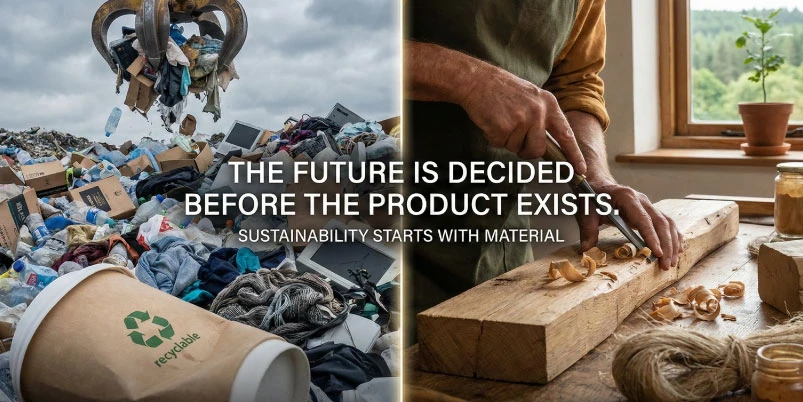
Most conversations around sustainability begin at the end. We debate recyclable packaging, reusable products, waste management, and carbon footprints. These discussions matter but they arrive after the most important choices have already been made. Sustainability does not begin with disposal. It begins with intention. Long before a product is held, displayed, or sold, a quieter decision defines its future. The end-product is only the visible result. The real decision is made much earlier at the moment a material is chosen.

What we see is the outcome. What we choose is the cause.

Material is never just material. It determines the process, sets the pace, and decides how much human skill is required. It shapes the systems that support production and the impact a product leaves behind. Change the material, and the entire story changes who makes it, how long it takes, how much energy it consumes, and what remains after use. Yet material is rarely questioned. We ask how a product looks, how much it costs, and how quickly it can be delivered. We judge sustainability by outcomes, not by origins.

We celebrate the finish, but ignore the beginning.

When synthetic or industrial materials are chosen, efficiency becomes the priority. Processes accelerate. Human skill becomes secondary. Scale replaces sensitivity. The product may look responsible on the surface, but the system behind it often tells a different story one that optimizes speed while quietly extracting value. When natural or traditional materials are chosen, the process slows down. Skill becomes essential. Knowledge is carried forward, not replaced. The pace may feel inconvenient, but the impact becomes layered economic, cultural, environmental, and human.

Speed creates volume. Continuity creates value.

Sustainability is not about how fast something is made. It is about how long its impact lasts.

Material choice determines behavior. It influences how something is produced, how it is priced, how it is valued, and how easily it is discarded. Products shaped by disposable materials are treated as disposable. Products shaped by living materials demand responsibility.

We don’t discard products. We discard the thinking behind them.

This is why sustainability cannot be repaired at the end of the chain. No amount of ethical branding or eco-friendly messaging can undo a decision that was careless at its source. True sustainability is not a label. It is a design decision. It requires asking uncomfortable questions early. What material is truly necessary? What skill does it honor? What kind of system does it create?

If the material is careless, the future built on it will be too.

Perhaps the most important shift we need is this: stop asking whether a product is sustainable. Start asking whether the material ever was. Because sustainability does not start with the product in our hands. It starts with the choice that made the product possible.

The future is decided , before the product exists.


Share Now

Download application to explore more

Bringing art into lifestyle