
Welcome offer: 10% off on your first order with code "SVAMART10" X
Conversation with the Aw...

Woven Through Time: The Untold Story of Rajasthan's 500-Year-Old Pattu Weaving Tradition

By Deepak Chandra 5 Views Jul 18, 2026
Woven Through Time: The Untold Story of Rajasthan's 500-Year-Old Pattu Weaving Tradition

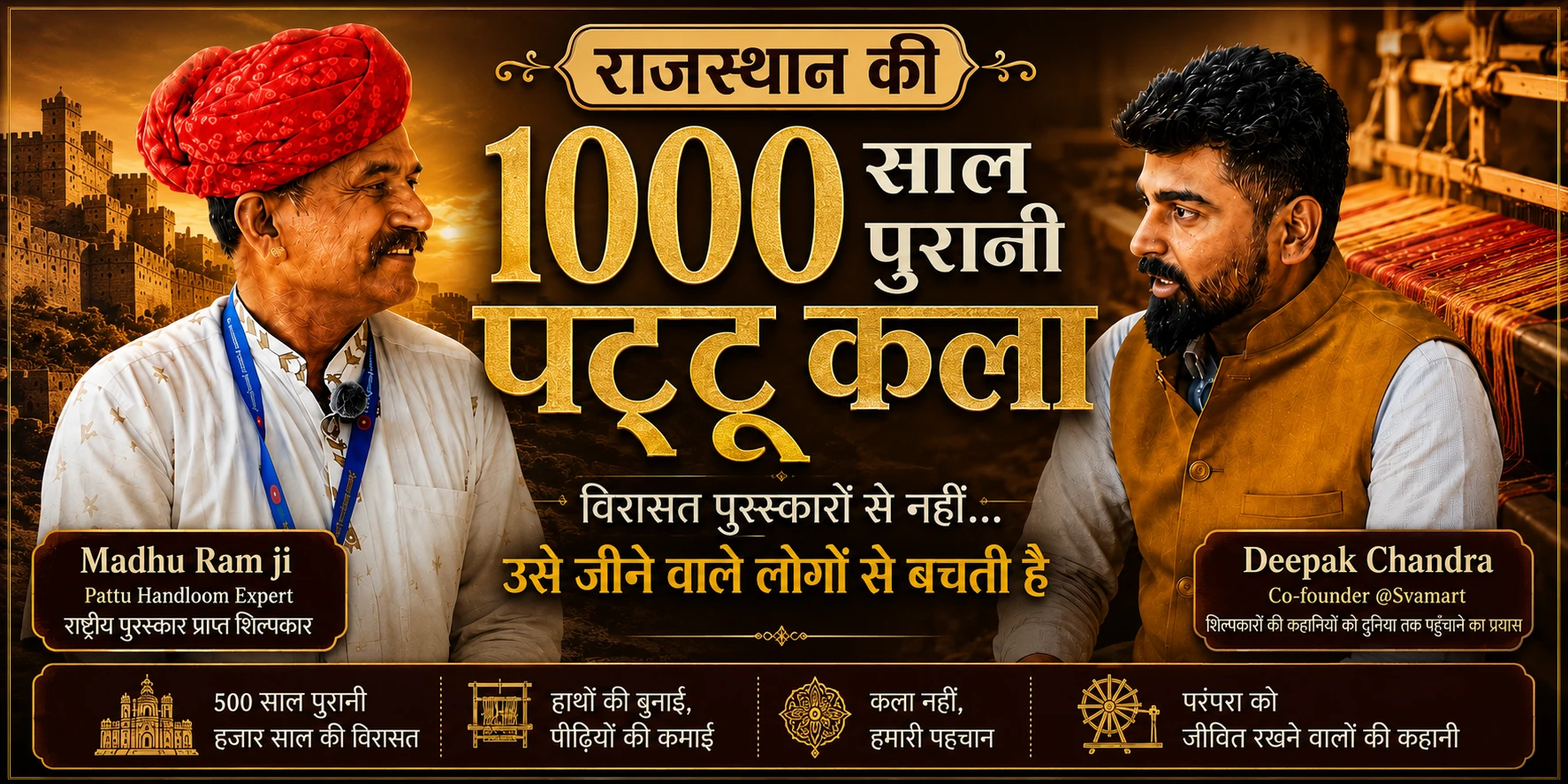
"विरासत पुरस्कारों से नहीं... उसे जीने वाले लोगों से बचती है।"

"Some traditions survive because they are documented. The rarest ones survive because someone chooses to dedicate an entire lifetime to them."

In an age where machines can produce thousands of textiles every hour, there are still places in India where every thread carries patience, every weave carries memory, and every finished piece carries generations of inherited wisdom.

One such place is Pokran, Rajasthan, where the rhythmic sound of a traditional handloom continues to echo through time. Here lives Master Weaver Madhu Ram Barupal, a National Award-winning artisan whose life's work is dedicated to preserving one of Rajasthan's oldest textile traditions Pattu Weaving.

Our conversation with him wasn't merely an interview about weaving.

It became a journey into India's cultural memory.

It was about "कला, कारीगर और संस्कृति"three words that together define the true spirit of Indian craftsmanship. At Svamart, we believe that every handmade product deserves a story before it deserves a price tag. Because once you understand the artisan, you never look at the product the same way again.

More Than a Weaver A Keeper of Heritage

Madhu Ram Barupal belongs to a family where weaving is not simply a profession but a tradition passed from one generation to another. Growing up in Pokran, he inherited the techniques, discipline, and philosophy of Pattu weaving from his forefathers. For more than fifty years, he has continued practicing this remarkable craft with the same dedication. Listening to him, one realizes that craftsmanship is not only about skill.

It is about responsibility.Every time he sits at the loom, he is not merely creating fabric. He is continuing a conversation that began centuries ago.

यही तो हमारी भारतीय परंपरा की सबसे बड़ी खूबसूरती है ज्ञान केवल पुस्तकों में नहीं, हाथों में भी जीवित रहता है।

What Exactly Is Rajasthan's Pattu Weaving?

For many people outside Rajasthan, the word Pattu is unfamiliar. Yet within western Rajasthan, especially the desert regions of Pokran, Jaisalmer, and Barmer, Pattu has been an integral part of life for centuries.

Traditionally woven using wool and cotton, Pattu textiles were designed to withstand the extreme climatic conditions of the Thar Desert.

Unlike mass-produced fabrics, handmade Pattu is valued for:

  1. Exceptional durability
  2. Natural warmth
  3. Rich textures
  4. Traditional geometric designs
  5. Sustainable production
  6. Cultural identity

Historically, these textiles were woven for shawls, blankets, and everyday traditional use But as lifestyles changed, so did consumer preferences. Many traditional crafts disappeared because they refused to adapt. Madhu Ram chose a different path.

Preserving Heritage Doesn't Mean Resisting Change

One of the most inspiring moments during our discussion was when Madhu Ram explained that preserving heritage does not mean freezing it in time.

Traditions survive only when they evolve without losing their soul. Recognizing changing lifestyles, he expanded Pattu weaving beyond traditional products.

Today, his workshop produces:

  1. Sarees
  2. Stoles
  3. Kurtas
  4. Jackets
  5. Home décor
  6. Table runners
  7. Contemporary textiles

This is not commercialisation. This is intelligent preservation.

"परंपरा तभी जीवित रहती है जब वह वर्तमान से संवाद करती है।"

Instead of asking modern consumers to return to the past, he has brought tradition into the present.

Awards Recognize Excellence. Dedication Preserves Civilization.

Over the years, Madhu Ram Barupal has received several prestigious honors including:

  1. National Award
  2. Sant Kabir National Handloom Award
  3. Rajasthan Bunkar Ratna Award

These recognitions celebrate his exceptional craftsmanship But throughout our conversation, something became very clear. Awards may recognize an artisan.

They do not preserve a tradition. People do. That is why the most powerful statement emerging from this documentary is:

"विरासत पुरस्कारों से नहीं... उसे जीने वाले लोगों से बचती है।"

Awards decorate walls. Dedication shapes history.

The Truth About Authentic Handmade Pattu

Today's market is flooded with machine-made imitations that often appear identical to handmade products. One of the most valuable lessons from our interview was Madhu Ram's explanation of authenticity. He insists on using high-quality cotton, wool, and long-lasting natural dyes. He also shared a fascinating way to identify genuine cotton. When pure cotton burns, it turns into soft ash. synthetic fibers melt into hard plastic-like beads. This simple demonstration reflects a much deeper philosophy. Authenticity is not marketing. Authenticity is honesty.

सच्चा हस्तशिल्प केवल सुंदर नहीं होता विश्वसनीय भी होता है।

Government Support Is Important

Madhu Ram also acknowledged the support received through initiatives such as the Samarth Scheme and the Weavers' Service Centre (WSC).

These programs helped artisans with training, upgraded looms, and solar-powered equipment. Institutional support plays an important role.

However, policies alone cannot preserve a craft. Governments can create opportunities. Markets can create demand But only artisans can keep knowledge alive.

His Message to India's Youth

Perhaps the most emotional part of our conversation came when Madhu Ram spoke about the younger generation. He believes every traditional craft faces one critical question:

Who will continue it?

If young people choose not to learn these skills, centuries of accumulated knowledge could disappear within a single generation. He encouraged youth especially women to see traditional craftsmanship not merely as heritage but as sustainable entrepreneurship.

Handloom is not only about culture. It is also about livelihoods. It is about dignity. It is about creating meaningful employment rooted in local communities.

"अगर अगली पीढ़ी नहीं सीखेगी, तो विरासत केवल संग्रहालयों तक सीमित रह जाएगी।"

The Philosophy Behind Handmade

The world today celebrates speed. Factories manufacture millions of identical products every day. Efficiency has become the standard. But efficiency cannot replace humanity. A handmade textile carries something machines cannot produce.

Human patience.

Human intention.

Human imperfection.

Every woven thread represents hours of concentration, years of practice, and generations of inherited wisdom. That is what makes handmade different.

It is not simply a product. It is accumulated human experience.

Svamart's Perspective: Beyond Products, Towards Purpose

At Svamart, our mission has never been limited to selling handcrafted products. We believe India's greatest luxury is not found inside shopping malls.

It lives inside artisan homes.Across villages. Inside workshops where generations continue practicing crafts that the world rarely gets to see. Unfortunately, most consumers only see the finished product.

They never meet the artisan. They never hear the story. They never understand the cultural significance behind what they are purchasing. That disconnect is one of the biggest challenges facing India's handmade ecosystem. Our vision is to bridge that gap. By documenting conversations like these, we hope to build appreciation before purchase Because when people understand the story, they stop comparing handmade with factory-made products. They begin appreciating value instead of merely comparing prices.

यही Svamart का उद्देश्य है कला, कलाकार और उपभोक्ता के बीच एक सार्थक संबंध बनाना।

Why Pattu Belongs in Modern Lifestyles

Many people still assume that heritage textiles belong only in museums or traditional ceremonies. Madhu Ram's work challenges that assumption. Pattu today can become part of contemporary homes through elegant table runners, throws, cushions, jackets, scarves, and lifestyle products.

Choosing handmade textiles is no longer simply about preserving culture. It is about making conscious lifestyle choices. It means choosing sustainability over excess.

Quality over quantity. Stories over mass production. When you bring handmade into your home, you are not simply decorating a space. You are giving space to someone's life journey.

Why This Conversation Matters

Every interview documents information. Some interviews document history. This conversation belongs to the second category.

It reminds us that India's cultural heritage does not survive because of monuments alone. It survives because thousands of artisans continue practicing their crafts quietly, patiently, and without expecting recognition. They are the invisible custodians of India's identity. Madhu Ram Barupal is one among them But his story represents countless artisans across the country who continue weaving, carving, painting, and creating despite changing markets and shrinking attention spans.

Heritage Is a Responsibility, Not Just a Memory

There is a profound difference between remembering heritage and living it. Museums preserve objects. Artisans preserve knowledge. One can display history. The other continues it.

As consumers, entrepreneurs, designers, researchers, and storytellers, we all have a role to play. Every purchase, every conversation, every documentary, and every effort to understand handmade traditions contributes to keeping these living legacies alive Because once a traditional craft disappears, it cannot simply be recreated. Centuries of experience disappear with it.

Final Reflection

Meeting Master Weaver Madhu Ram Barupal was more than an opportunity to document Rajasthan's Pattu weaving tradition. It was a reminder that India's greatest treasures are not always found inside monuments or museums.Often, they are found in the quiet determination of artisans whose hands continue weaving stories that history books cannot fully capture. His journey teaches us that heritage is not measured by the number of awards received. It is measured by the number of generations inspired. As we concluded our conversation, one thought stayed with us:

"विरासत पुरस्कारों से नहीं... उसे जीने वाले लोगों से बचती है।"

At Svamart, we don't just document handmade products. We document the people who ensure that India's timeless traditions continue to have a future.


Share Now

Discover authentic handmade treasures.

Shop consciously. Live consciously.