
Your cart is empty, and it looks like you haven’t added anything yet.
Tucked inside the Bulandshahr district of Uttar Pradesh, Khurja has carried the quiet identity of India's ceramic capital for well over six hundred years. Look around your kitchen right now. That modest tea cup. The white ceramic bowl you reach for every morning. The dinner plates passed down from a relative. There is a very real chance that what you are holding was born in a small town called Khurja a place most people cannot locate on a map, yet whose products live inside almost every Indian home. Its story traces back to the Mughal era, when skilled craftsmen from Turkestan and Persia settled here and planted the seeds of a stoneware tradition that would one day clothe the tables of an entire subcontinent.
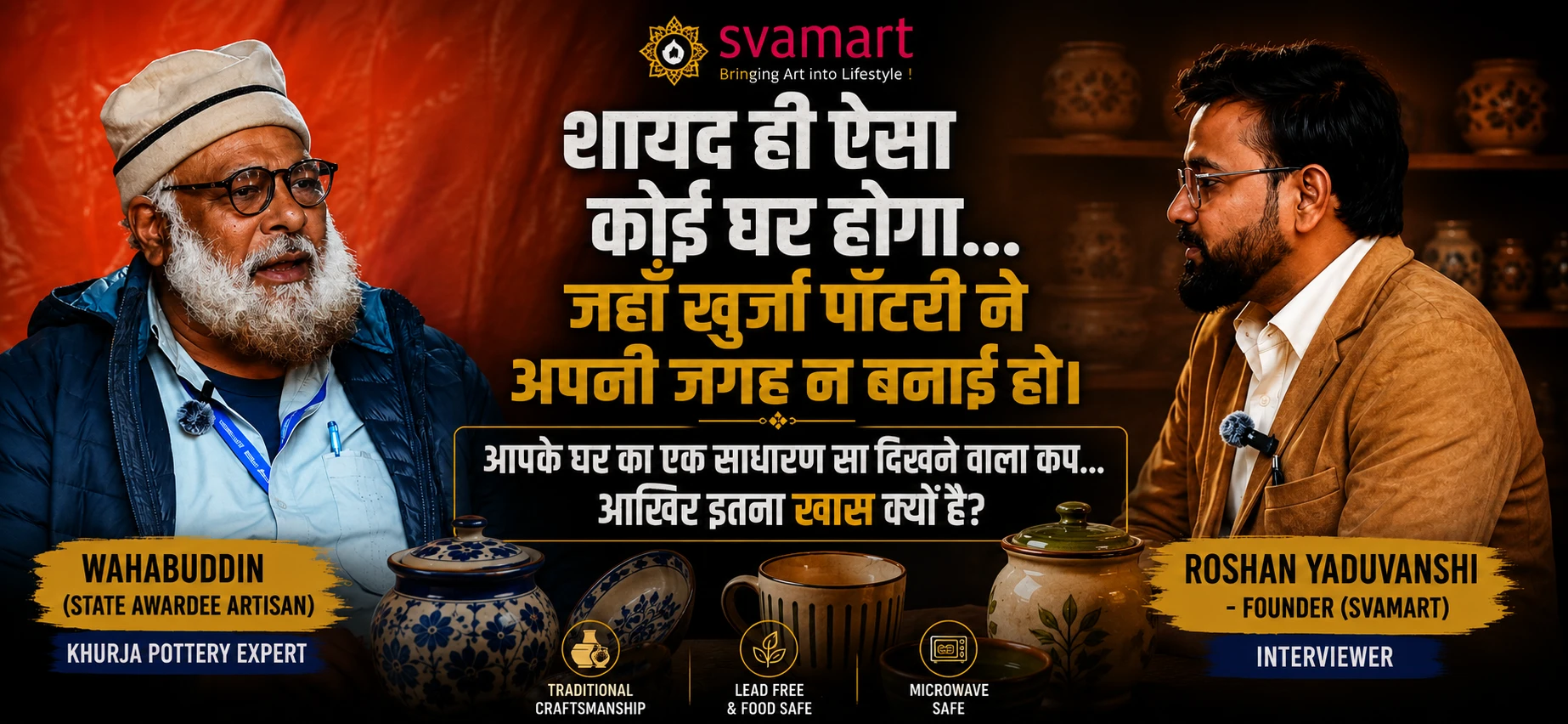
Long before plastic entered Indian kitchens, clay ruled them. For centuries, the humble potter's wheel has shaped not just vessels, but the very rhythm of daily life across India from the terracotta water pots cooling summer afternoons in Rajasthan, to the ceramic chai cups clinking on railway platforms across the country.At the heart of this tradition lies Khurja, a small town in Uttar Pradesh's Bulandshahr district, quietly holding one of India's most celebrated and prolific ceramic legacies. Known as the "Pottery Town of India," Khurja has produced ceramic ware for over 600 years, supplying hotels, households, and export markets with its distinctive glazed pottery. Unlike decorative crafts displayed behind glass, Khurja pottery is functional it belongs on your dining table, in your hands, in your daily life. To understand this craft from the inside, journalist Roshan sat down with Wahabuddin Ji, a State Award winning artisan whose hands have shaped thousands of pieces across decades. What follows is not just a conversation about clay it is a window into resilience, expertise, and a way of life under quiet but constant pressure.
One of the most common misconceptions among the general public is conflating two very different crafts. Roshan opened the conversation with this very question:
Q1. Roshan: लोग अक्सर खुर्जा पॉटरी और ब्लू पॉटरी को एक ही समझ लेते हैं। दोनों में सबसे बड़ा अंतर क्या है?
Wahabuddin Ji: सबसे बड़ा अंतर इनके मटेरियल और निर्माण प्रक्रिया में है। ब्लू पॉटरी और खुर्जा पॉटरी दोनों अलग-अलग शिल्प हैं। खुर्जा पॉटरी मुख्यतः सिरेमिक आधारित होती है और आजकल इसमें Lead-Free Glaze का प्रयोग किया जाता है, जिससे यह खाने-पीने के लिए सुरक्षित होती है। वहीं ब्लू पॉटरी की तकनीक और उपयोग अलग है।
The distinction Wahabuddin Ji draws is significant. Blue Pottery, synonymous with Jaipur and rooted in a Persian-Mughal aesthetic tradition, is primarily decorative. Khurja pottery, by contrast, is ceramic-based, utility-driven, and increasingly manufactured with lead-free glazes making it safe for everyday food and beverage use.
Q2. Roshan: खुर्जा पॉटरी में किन-किन प्रकार के मटेरियल का उपयोग किया जाता है और Lead-Free होने का क्या महत्व है?
Wahabuddin Ji: हमारे उत्पादों में Lead-Free Glaze का उपयोग किया जाता है। इसका सबसे बड़ा लाभ यह है कि यह खाने-पीने के लिए सुरक्षित होता है और माइक्रोवेव में भी इस्तेमाल किया जा सकता है। आज ग्राहक स्वास्थ्य और सुरक्षा को लेकर पहले से अधिक जागरूक हैं, इसलिए Lead-Free Ceramic की मांग लगातार बढ़ रही है।
This is a crucial evolution in the craft. Older glazing techniques across many traditions historically used lead compounds to achieve smooth, glossy finishes a practice now recognized as a health hazard. Khurja's transition to lead-free glazing reflects the industry's adaptation to modern safety standards, without sacrificing the visual appeal of the product.
Many consumers assume that ceramic is universally heat-resistant. Wahabuddin Ji corrects this with the directness of someone who has probably answered this question a hundred times:
Q3. Roshan: क्या खुर्जा पॉटरी के सभी उत्पाद गैस स्टोव और माइक्रोवेव दोनों में इस्तेमाल किए जा सकते हैं?
Wahabuddin Ji: नहीं। Microwave Safe और Flame Safe दोनों अलग बातें हैं। हमारे अधिकांश उत्पाद माइक्रोवेव के लिए सुरक्षित होते हैं, लेकिन इन्हें सीधे गैस की आंच पर नहीं रखा जा सकता। ऐसा करने पर उत्पाद क्रैक हो सकता है।
A single "No" succinct, definitive followed by a patient explanation. This is the voice of a craftsman who respects both his materials and his customers.
Behind every simple ceramic mug on a café shelf lies a complex, multi-stage process that most of us never consider:
Q4. Roshan: एक साधारण दिखने वाला कप या मग बनने के पीछे पूरी प्रक्रिया क्या होती है?
Wahabuddin Ji: एक उत्पाद कई चरणों से गुजरता है मटेरियल तैयार होता है, Casting होती है, Drying होती है, Glazing की जाती है, फिर उसे उच्च तापमान वाली भट्टी में पकाया जाता है। इसके बाद Quality Check होता है। तभी जाकर एक तैयार उत्पाद बाजार तक पहुंचता है।
Six distinct stages. Each one demands skill, patience, and precision. A mug that costs ₹80 at a market stall has passed through the hands of multiple experts and survived an intense gauntlet of fire and inspection.
Q5. Roshan: इस पूरी प्रक्रिया में सबसे कठिन और सबसे जोखिम भरा चरण कौन-सा होता है?
Wahabuddin Ji: सबसे बड़ा जोखिम भट्टी (Kiln Firing) का होता है। अगर तापमान या प्रक्रिया में छोटी-सी भी गलती हो जाए, तो पूरी भट्टी का माल खराब हो सकता है। उसमें लगाया गया Raw Material, Chemical, Labour और Fuel सबका नुकसान हो जाता है।
This is the moment that keeps potters awake at night. Every piece in the kiln represents hours of labour and weeks of material investment. A temperature fluctuation, a faulty seal, a miscalculation and everything is lost in a single firing. There is no partial loss. The kiln demands perfection or takes everything.
Q8. Roshan: आज खुर्जा पॉटरी उद्योग के सामने सबसे बड़ी चुनौती क्या है?
Wahabuddin Ji: आज सबसे बड़ी चुनौती बाजार की मंदी है। कई बार इतना काम करने के बाद भी लागत निकलना मुश्किल हो जाता है। कभी-कभी पूरा निवेश होने के बावजूद बिक्री नहीं होती। कारीगर केवल उत्पाद नहीं बना रहा, बल्कि हर दिन एक जोखिम भी उठा रहा है।
Behind the artistry lies economic vulnerability. Today, approximately 25 workers depend on Wahabuddin Ji's unit, each with a family relying on this income. The craft is not a romantic pursuit it is a livelihood that hangs in the balance between market forces and cultural neglect.
The shift to lead-free glazing in Khurja pottery is not just an upgrade it is a declaration that traditional craft can evolve without losing its soul. As consumers become more health-conscious, ceramic dinnerware offers a genuine, scientifically sound alternative to plastic and melamine products that leach chemicals into food, especially when heated.
The environmental calculus here is also worth examining. Ceramics are:
If Khurja pottery declines through market neglect, lack of artisan support, or pricing competition from cheap imports the vacuum will not remain empty. It will be filled by plastic, fibre, and synthetic materials. The consequences of this shift deserve scrutiny:
For Health: Plastic containers, especially when repeatedly heated in microwaves, release microplastics and endocrine-disrupting chemicals. Ceramic, when properly glazed with lead-free materials as Wahabuddin Ji emphasises, carries no such risk.
For the Environment: Mass-produced plastic crockery contributes enormously to non-biodegradable waste. India already faces a plastic pollution crisis of staggering proportions. Replacing sustainable ceramic with more plastic is a step sharply in the wrong direction.
For Culture: The disappearance of Khurja pottery would mean the erasure of a 600-year-old craft tradition, the loss of a GI tagged (Geographical Indication) product unique to Indian heritage, and the silencing of an entire vocabulary of artisanal knowledge knowledge that lives in hands, not textbooks.
Wahabuddin Ji's unit alone supports 20–25 workers. Multiply this across the hundreds of units in Khurja, and you have a substantial micro-economy one that operates without corporate backing, without government contracts, and largely without the consumer awareness it deserves. The market slowdown he describes is not an abstract economic problem. It is a daily human crisis: artisans who have mastered a complex, multi-stage craft finding themselves unable to recover their costs.
Unlike factory workers, these artisans carry entrepreneurial risk. They invest in raw materials, chemicals, fuel, and labour before a single piece is sold. The kiln does not offer refunds.
Wahabuddin Ji's interview is, at its core, a quiet act of resilience. He does not dramatise his craft or plead for sympathy. He simply explains with precision, with pride, and with the calm authority of someone who has dedicated his life to making beautiful, useful things out of earth and fire.
But awareness alone is not preservation. If we value the health benefits of lead-free ceramic, the environmental logic of durable clay over disposable plastic, and the cultural richness of a 600-year tradition then that valuation must translate into conscious consumer choices. Every cup of chai served in Khurja ceramic is a small vote for a more sustainable, more culturally grounded India.
Support the artisans. Choose the craft. Pass it on.
To see Wahabuddin Ji speak about his craft in his own words his workshop, his process, and the life behind every piece of pottery watch the full video interview here:
🎥 Understanding Khurja Pottery from the Artisan Himself — Full Interview
Take twenty minutes to learn something that took a lifetime to master.
You need to Sign in to view this feature
This address will be removed from this list