
Welcome offer: 10% off on your first order with code "SVAMART10" X
Sustainability & Circular...

Why Sustainability Feels Like Effort Today

By Deepak Chandra 35 Views Dec 29, 2025
Why Sustainability Feels Like Effort Today

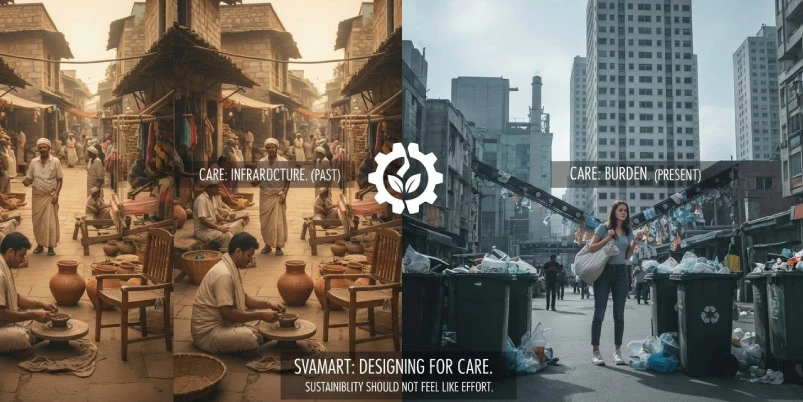
Sustainability today feels like effort. Jaise ek extra responsibility ho jo normal life ke upar add ho gayi ho. Jaise care ko consciously practice karna padta ho, warna system apni default direction me hi chalta rahega. But this discomfort is not natural. It is designed. There was a time when sustainability did not exist as a term because it did not need to. Care was embedded into everyday systems, quietly and consistently, without demanding attention or discipline from individuals.

Care was not a choice.It was infrastructure.

Traditional systems never relied on personal morality to function responsibly. They relied on structure. Materials were selected based on availability and renewal. Production moved at a pace that human bodies and natural cycles could sustain. Objects were made to age, to be repaired, and to stay in circulation. Waste was limited not because people were environmentally conscious, but because systems did not allow excess to accumulate. Effort was not required because resistance did not exist.

Sustainability only feels heavy when it has to fight the system.

Today, sustainability feels like labour because care has been removed from design and relocated to individual behaviour. We are asked to recycle what was never meant to return. We are encouraged to make ethical choices inside markets built for speed and disposability. We are expected to stay mindful while operating in systems that fragment attention and reward convenience. What was once structural has become personal, and what was once automatic now feels like sacrifice.

When care leaves systems, it reappears as burden.

Modern systems celebrate convenience as progress, but convenience is not neutral. It transfers effort from production to consumption. It reduces responsibility at the point of creation and increases it at the point of disposal. Earlier systems carried this weight silently through material limits, slower processes, and skill-based production. Today, individuals are asked to compensate for what systems refuse to account for.

Care has been outsourced to conscience.

This is why sustainability often feels exhausting. Not because people lack concern, but because concern has been placed downstream. When materials are chosen for speed, responsibility feels slow. When products are designed for replacement, choosing longevity feels like resistance. When systems optimise extraction, restraint begins to feel like loss.

Care was never meant to feel heroic, It was meant to feel normal.

The real issue is not why people struggle to live sustainably. The real issue is why systems stopped supporting sustainability by default. Why did repair disappear from daily life? Why did materials stop aligning with natural cycles? Why did skill become optional rather than foundational? These questions point upstream, not at individual behavior.

At Svamart, sustainability is approached not as a lifestyle challenge, but as a design principle. When materials are respected, systems slow down naturally. When systems slow down, skill finds space. When skill finds space, care stops feeling heavy. It becomes part of how things are made and used, not something added later.

The future of sustainability may not depend on doing more. It may depend on designing systems that require less compensation. Sustainability should not feel like effort. If it does, something earlier in the system is broken.

Share Now

Download application to explore more

Bringing art into lifestyle