
Your cart is empty, and it looks like you haven’t added anything yet.
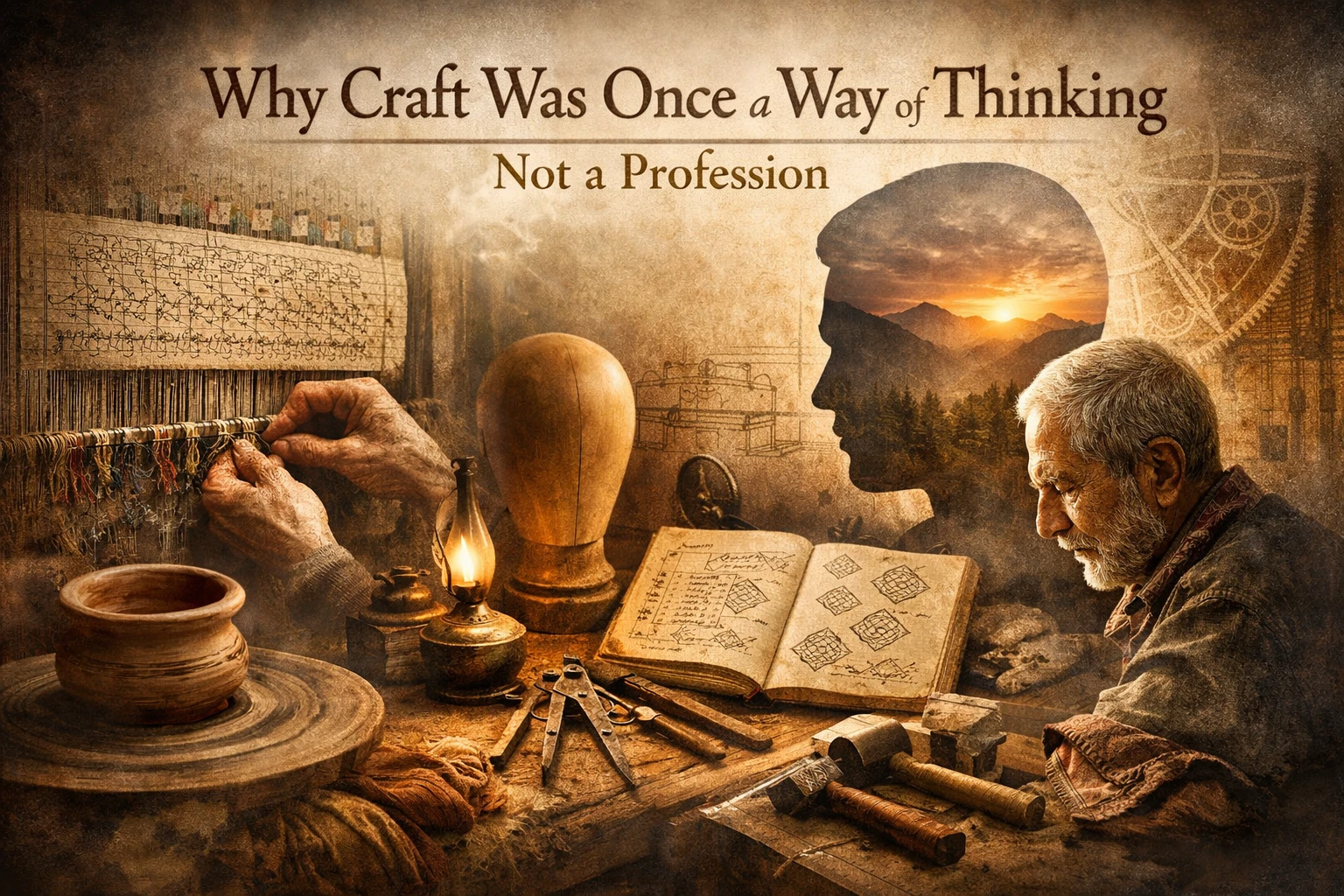
Today, craft is described as a profession. A livelihood. A category. Something you do to earn. But historically, craft was never confined to occupation. It was a way of thinking, a method of understanding the world through hands, materials, and time. In traditional systems, people did not “learn a craft” separately from life. They grew into it. Observation, repetition, patience, and restraint were absorbed naturally. Craft shaped how one approached work, decisions, and even relationships. It trained the mind to respect process over outcome. Kaam aur soch alag nahi the. Kaam hi soch tha.
Craft once taught systems thinking long before the term existed. A weaver understood tension, balance, and rhythm. A potter understood limits, timing, and fragility. A metalworker understood heat, control, and consequence. These were not abstract lessons. They were embodied knowledge. Every mistake had immediate feedback. Every shortcut had visible cost. Craft trained accountability because the material responded honestly. You could not argue with clay, wood, or thread. They forced the maker to think ahead, slow down, and adapt.This is why traditional crafts produced thinkers who were grounded, not speculative. Their intelligence came from engagement, not abstraction.
Material sirf medium nahi tha. Material teacher tha.
The shift happened when production was separated from understanding. Industrial systems broke processes into tasks. Skill became repeatable. Thinking was outsourced to systems, manuals, and machines. Craft turned into a profession something measured by output, speed, and cost. Once craft became a job title, its deeper role disappeared. The work survived, but the thinking faded. Making was reduced to execution. Learning was reduced to training. And the maker was no longer required to understand the whole.
Jab kaam sirf kaam reh jaata hai, tab uska matlab kho jaata hai.
We live in a world filled with professionals but starving for thinkers. Efficiency is high, but understanding is shallow. Systems run fast, but break easily. This is not accidental. It is the result of removing thinking from making. Craft as a way of thinking taught people how to stay with complexity, how to wait for outcomes, and how to respect limits. These qualities are essential today especially in conversations around sustainability, resilience, and long-term impact.
At Svamart, Material Matters is rooted in this idea. When craft is treated as thinking, materials regain meaning, skills regain dignity, and systems regain balance. Sustainability stops being a claim and becomes a consequence. Perhaps the future does not need more professions. It needs a return to ways of thinking that once came naturally through making, through patience, and through respect for process. Craft was never just about objects.It was about how humans learned to live with the world.
You need to Sign in to view this feature
This address will be removed from this list