
Welcome offer: 10% off on your first order with code "SVAMART10" X
Stories & Prospectives

Why Craft Is Not a Product But a Philosophy for Modern Life

By Roshan Yaduvanshi 4 Views Jan 13, 2026
Why Craft Is Not a Product But a Philosophy for Modern Life

Modern life appears rich with opportunity. Choices surround us what to study, where to work, what to buy, who to become. Yet beneath this abundance lies a quiet exhaustion. People today are not merely busy; they are mentally overburdened. The pressure to choose correctly, repeatedly, and independently has turned everyday life into a continuous test of performance. What we often fail to notice is that this pressure is not accidental. It is shaped by a worldview where education becomes investment, knowledge becomes capital, and human beings slowly transform into units of productivity and consumption. In such a system, success is framed narrowly: study well, behave correctly, secure a job, earn, and consume. Meaning is postponed, outsourced, or quietly forgotten. This way of living does not collapse loudly. It erodes silently through anxiety, dissatisfaction, and a persistent sense that something essential is missing.

From Social Beings to Market Subjects

When education is reduced to labour-market readiness, learning loses its human depth. Schools begin competing like businesses. Students are prepared not to understand themselves, but to fit into systems that demand efficiency, adaptability, and constant upgrading. Responsibility for success and failure is placed entirely on individuals, while the structures shaping those outcomes remain unquestioned.

In this framework, consumption becomes the central social activity. What we buy does not just satisfy needs; it begins to define identity. Choices are no longer only about products but about who we are becoming. And yet, with every choice comes uncertainty was this the best option? Could there have been something better? There is no shared moral framework to fall back on, no collective reassurance. If things go wrong, there is no one to blame but oneself. This is the psychological cost of a society that celebrates freedom of choice without teaching how to live with choice.

Why Complexity Feels Unmanageable

Life today is not only faster; it is structurally more complex. From financial systems to healthcare, from technology to social norms, individuals are expected to manage systems that were once handled collectively or institutionally. This complexity creates a gap a gap between external demands and internal capacities.

Young people are especially vulnerable. They are expected to make life-defining decisions before they have had the chance to understand themselves. Often lacking stable guidance, moral modelling, or safe spaces for gradual growth, many struggle not because they are incapable, but because the environment overwhelms them. The question then arises: can education offer something more than preparation for employment? Can it help individuals develop the inner resources required to navigate uncertainty, complexity, and responsibility?

Craft as a Manageable World

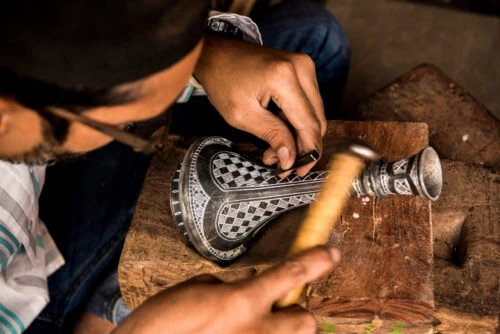
Craft offers something modern life rarely does: a contained, understandable process. Making something by hand has a beginning, a middle, and an end. Materials respond honestly. Actions have visible consequences. Effort and outcome are directly connected. In a world that feels abstract and unpredictable, craft creates a small universe where order naturally emerges. The maker learns that materials have limits, that patience matters, and that quality cannot be rushed. Mistakes are not failures; they are information. Improvement is possible through attention, not anxiety. This experience restores a sense of agency. One is no longer just reacting to systems but actively shaping outcomes.

Hands Are Not Separate from the Mind

For a long time, manual work has been wrongly positioned as inferior to intellectual labour. This false hierarchy has distanced education from bodily engagement, especially during the years when such engagement is most needed. Neuroscience now tells a different story. Motor activity and cognitive development are deeply interconnected. When hands learn, the brain reorganizes. Skills acquired through physical making influence attention, problem-solving, memory, and emotional regulation. Learning through the body is not primitive it is foundational. Craft challenges the illusion that thinking happens only in the head. It reminds us that understanding often begins in touch, resistance, texture, and movement.

An Alternative to Consumerism

Craft stands in quiet opposition to a throwaway culture. When you make something, you become aware of material limits. Waste is not invisible. Repair becomes meaningful. Consumption slows down not because of moral instruction, but because of lived understanding.

Those who engage in making often consume less, value relationships more, and find satisfaction in development rather than accumulation. Sustainability, in this context, is not an abstract goal. It becomes a natural outcome of respect for materials, processes, and effort.

This is why craft does not merely produce objects; it cultivates a different way of seeing the world.

Identity Beyond Consumption

The market constantly asks: what can you buy? Craft asks something far more fundamental: what can you create?

In making, individuals encounter themselves not as profiles or data points, but as capable beings. The experience of shaping material fosters dignity, confidence, and a grounded sense of self. Identity becomes something built, not displayed. This is particularly powerful for young people searching for belonging and meaning. Craft offers a space where worth is not measured by speed or comparison, but by engagement and sincerity.

Rethinking What Education Is For

If education focuses only on measurable academic outputs, it risks neglecting the experiences that make life comprehensible, manageable, and meaningful. Craft contributes precisely to these dimensions. It teaches decision-making without paralysis, responsibility without fear, and effort without alienation. It does not prepare students merely for jobs; it prepares them for life.

Returning to the Act of Making

Perhaps the crisis of modern living is not a lack of innovation, but a loss of connection to process, to material, to one’s own agency. Craft reconnects us with these foundations. It reminds us that before we were consumers, we were makers. Before we optimized systems, we shaped tools with our hands.

Reclaiming craft is not nostalgia. It is a necessary correction.

Share Now

Download application to explore more

Bringing art into lifestyle