
Your cart is empty, and it looks like you haven’t added anything yet.
Traditional systems understood something very fundamental about human rhythm that modern systems largely ignore: humans are not machines, and life does not move in straight, repeatable lines. Traditional systems were built around cycles, not targets. They observed the body, the seasons, the materials, and the mind, and aligned work with those rhythms. Craft happened when the body was ready, materials were receptive, and attention was present. Productivity was not measured by speed, but by appropriateness. When to work mattered as much as how much to work.Traditional systems never asked humans to behave like machines.
Unhone life ko observe kiya, body ko samjha, seasons ko feel kiya aur phir systems banaye. Work unke liye sirf output nahi tha; woh ek rhythm tha.
Modern systems targets pe chalte hain. Traditional systems cycles pe. Aur yahin se difference shuru hota hai.
Traditional systems samajhte the ki har din same nahi hota. Har haath same energy ke saath kaam nahi karta. Kabhi flow hota hai, kabhi rukna padta hai. Isliye kaam ko clock ke hisaab se nahi, capacity ke hisaab se design kiya gaya.
Productivity was never about speed. It was about suitability.
Craft traditions mein kaam tab hota tha jab body ready ho, material receptive ho, aur mind present ho. Kapda tab bunta tha jab humidity sahi ho. Rang tab lagta tha jab surface taiyaar ho. Yeh delay nahi tha yeh intelligence thi. Yeh log efficiency se zyada appropriateness pe bharosa karte the. Aaj hum delay ko problem kehte hain. Tab delay ko process kaha jata tha. Traditional systems variation ko galti nahi maante the. Har line ka thoda alag hona acceptable tha kyunki woh batata tha ki kaam zinda haath ne kiya hai. Human mood, breath, aur presence ka thoda sa farq har creation mein dikhta tha. Modern systems variation ko error bolte hain. Uniformity ko quality bolte hain. Par sach yeh hai:
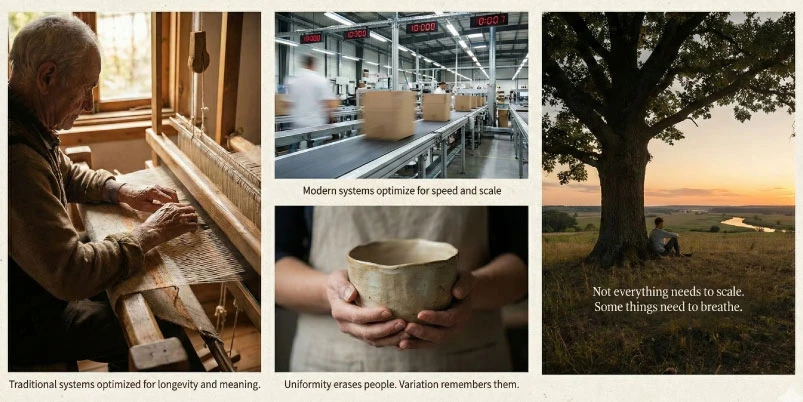
Uniformity erases people. Variation remembers them.
Most importantly, traditional systems understood attention as a limited resource. Work was designed so the mind could stay with the hand. Once attention breaks, quality collapses. Modern systems optimise for output even when attention is fractured, which leads to exhaustion, detachment, and disposability. In essence, traditional systems worked with human rhythm, not against it. Modern systems demand humans adjust to systems. And that is where meaning, care, and sustainability begin to erode.
Jo system rukna bhool jaata hai, woh tootna seekh leta hai.
Modern systems output badhate hain, chahe attention toot jaye. Result? Burnout, detachment, disposability.
Jab haath kaam kare aur mind kahin aur ho,toh sirf cheezein banti hain connecction nahi.
This is not about romanticizing the past. It is about understanding what the future demands. The climate crisis, declining mental health, shrinking attention spans these are not isolated problems. They are symptoms of systems that have lost their sense of rhythm. When human life is designed around constant acceleration, exhaustion becomes normalized and imbalance becomes invisible. Traditional systems did not resist progress. They simply understood that continuity requires pauses, that regeneration needs time, and that human energy is not infinite. Modern systems optimize for speed and scale; traditional systems optimized for longevity and meaning.
At Svamart, this understanding forms the foundation of how we think about materials, craft, and sustainability. Indigenous practices remind us that systems can move forward without erasing what came before. When rhythm is respected, skill finds space. When skill is valued, continuity becomes possible.
Civilisations don’t collapse due to lack of innovation. They collapse when rhythm is replaced by rush.
The future may not need constant invention. It may need remembrance that time has a pulse, materials have memory, and human systems thrive when they move in harmony rather than haste.
Not everything needs to scale. Some things need to breathe.
You need to Sign in to view this feature
This address will be removed from this list