
Your cart is empty, and it looks like you haven’t added anything yet.
We often speak about sustainability as if it is something we misplaced along the way as if modern life accidentally dropped it somewhere between innovation and convenience. We search for it in technologies, certifications, policies, and habits. But the more we search, the more complicated it seems. Perhaps the problem is not that sustainability is missing. Perhaps the problem is that the condition required for sustainability no longer exists.
That condition is patience.
Earlier systems did not chase sustainability as an outcome. They lived inside it because they were built at a pace that allowed balance to form naturally. Time was not treated as a resource to compress, but as a medium things moved through. Materials took time. Skills took time. Relationships with objects took time. Aur isme koi heroism nahi tha. Yeh normal life ka hissa tha. Sustainability koi “effort” nahi thi.Woh patience ka side-effect thi.
Traditional systems understood something modern systems struggle to accept that not everything can be rushed without consequence. Kapda tab bunta tha jab haath ready hota tha. Rang tab lagta tha jab surface usse accept kar sakta tha. Repair hota tha kyunki time tha, aur replacement ka pressure nahi tha. Delay ko inefficiency nahi maana jata tha. Delay ko process kaha jata tha. Patience was not a virtue.It was infrastructure.
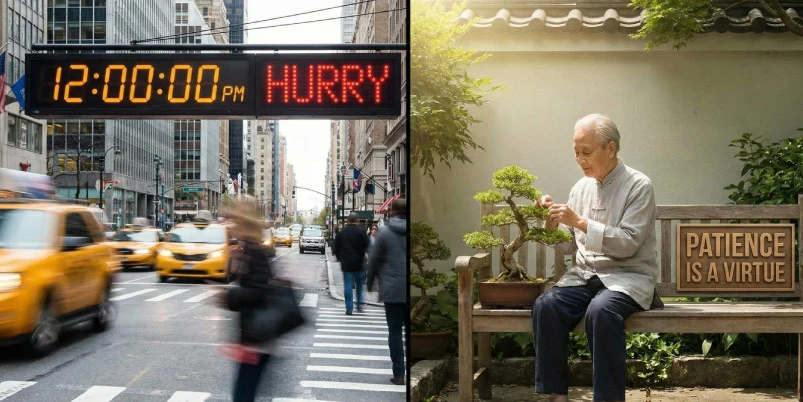
Modern systems, however, are built on a very different instinct. Speed is celebrated. Waiting is penalised. Anything that slows momentum is seen as waste. Faster delivery, faster production, faster decisions yeh sab progress ke symbols ban gaye. In such systems, patience feels outdated, even irresponsible. Aur jab patience ko hata diya jata hai, sustainability apne aap system se nikal jaati hai.
What we call progress today is often acceleration without absorption.
When patience disappears from design, sustainability turns into labour. Responsibility jo pehle structure ke andar thi, ab individual ke kandhon pe aa jaati hai. We ask people to recycle what was never designed to return. We ask for restraint in systems built on excess. Hum logo se kehte hain “be conscious,” jab environment hi distraction ke liye design kiya gaya ho. Jab patience system se nikal jaati hai, care conscience pe shift ho jaata hai.
This is why sustainable choices feel inconvenient today. Repair feels slow in a world trained for replacement. Longevity feels expensive in markets that depend on turnover. Natural materials feel demanding because they don’t obey industrial timelines. Patience ko inefficiency ka label de diya gaya, jabki asal mein wahi intelligence thi.
Impatience does not destroy systems immediately. It makes them brittle first.
Fast systems look impressive, but they lack depth. They exhaust resources quickly not just environmental resources, but human ones. Attention thak jaata hai. Skill shallow ho jaati hai. Meaning thin ho jata hai. Aur phir hum hairaan hote hain ki burnout, waste, aur dissatisfaction itni normal kyun ho gayi. Speed solves for volume. Patience solves for continuity. The irony is that impatience rarely saves time. It only postpones cost. Waste accumulates. Repair disappears. Skills fade. Aur jo cheez patience thoda sa time le kar solve kar sakti thi, usse baad mein fix karne ke liye bahut zyada effort chahiye hota hai.
At Svamart, sustainability is not approached as a behavioural problem. It is seen as a design question rooted in patience. Jab material choice thoughtful hoti hai, process naturally slow hota hai. Jab process slow hota hai, skill ko jagah milti hai. Jab skill zinda rehti hai, cheezein zyada time tak chalti hain. Aur jab cheezein chalti hain, care ko force nahi karna padta.
Patience doesn’t feel heavy when systems are built to carry it.
The real question is not how to make people more sustainable. The real question is how to rebuild systems that allow patience to return quietly without marketing, without guilt, without applause. Systems jahan waiting waste nahi ho, repair inconvenience nahi ho, aur longevity ko problem nahi maana jaaye. Perhaps sustainability does not need louder conversations. Perhaps it needs slower ones. Because we didn’t lose sustainability.
Humne patience kho di. Aur jab tak patience wapas systems mein nahi aati material mein, process mein, aur decision-making mein tab tak sustainability ek burden hi lagegi, instead of what it once was: a natural way of living.
You need to Sign in to view this feature
This address will be removed from this list