
Welcome offer: 10% off on your first order with code "SVAMART10" X
Decoding craft philosophy

Indigenous Art Was Never Decorative. It Was Direction.

By Sarita Rai 28 Views Jan 04, 2026
Indigenous Art Was Never Decorative. It Was Direction.


Today, indigenous art is often framed as something to admire. A visual heritage. A cultural asset. Something beautiful that belongs in museums, exhibitions, or curated collections. But this framing strips indigenous art of its original purpose. Because indigenous art was never created only to be seen. It was created to be understood, followed, and lived with. Indigenous art was instruction before it was expression.

Long before classrooms existed, art carried knowledge. Before books entered homes, materials carried memory. Before rules were written, patterns reminded people how to behave with nature, with community, and with themselves. Art did not decorate life; it structured it.

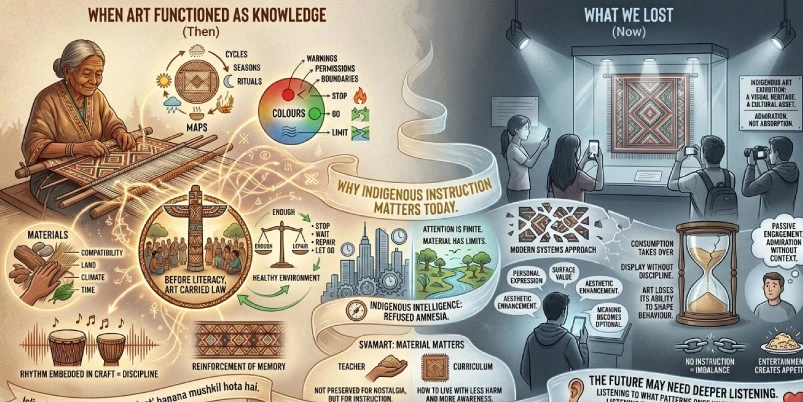
When Art Functioned as Knowledge, Not Decoration

Patterns in indigenous art were not random motifs. They were maps. They explained cycles of seasons, of labour, of rituals, of restraint. Colours were not chosen for harmony alone; they carried warnings, permissions, boundaries. Materials were selected not for convenience, but for compatibility with land, climate, and time.

Before literacy, art carried law. Before design, material carried intelligence. Indigenous art taught people how much was enough. It taught when to stop, when to wait, when to repair, and when to let go. A motif repeated across generations was not repetition for beauty; it was reinforcement of memory. A rhythm embedded in craft was not style; it was discipline. Traditional systems never separated art from life. Isliye indigenous art ko “product” banana mushkil hota hai. Because it was not meant to be consumed.

What We Lost When Art Stopped Instructing

Modern systems approach art differently. Art becomes personal expression, surface value, or aesthetic enhancement. Meaning becomes optional. Instruction disappears. When art stops instructing, consumption takes over. We admire without absorbing. We collect without context. We display without discipline And slowly, art loses its ability to shape behaviour.

Indigenous art demanded participation. It asked the viewer to slow down, to recognise symbols, to understand cycles, to respect limits. It did not allow passive engagement. To live with such art was to live with reminders reminders of restraint, continuity, and accountability.

When art instructs, it creates balance. When art entertains, it creates appetite.

Why Indigenous Instruction Matters Today

This is why indigenous art feels deeply relevant today, not because it is old, but because it understands something modern systems struggle with that human life cannot be sustained on speed alone. That attention is finite. That material has limits. That repetition without meaning empties culture.

Indigenous intelligence did not reject progress. It simply refused amnesia.

At Svamart, this understanding shapes how Material Matters is interpreted. Material is not treated as raw input. It is treated as a teacher. Craft is not treated as output. It is treated as curriculum. Indigenous art is not preserved for nostalgia, but for instruction because it still teaches us how to live with less harm and more awareness.

The future may not need more design innovation. It may need deeper listening. Listening to what patterns once warned us about. Listening to what materials still remember. Listening to what indigenous systems already knew that sustainability was never a separate goal.

It was simply the result of living by instruction rather than impulse.

Some art is not meant to be admired, It is meant to be followed.


Share Now

Download application to explore more

Bringing art into lifestyle