
Your cart is empty, and it looks like you haven’t added anything yet.
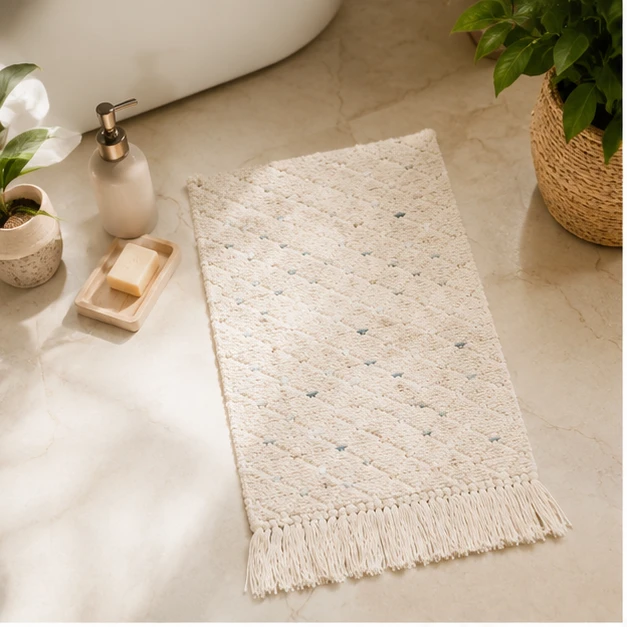
Handknotted carpets are often appreciated for their softness, density, and intricate patterns. We walk over them, admire their symmetry, and speak about knot counts and durability. But the true nature of a hand knotted carpet reveals itself not in how it feels underfoot, but in how it is made.
Unlike many crafts where beauty appears gradually, carpet weaving hides its reward until the very end. In the hand knotted carpet tradition of Uttar Pradesh, particularly in regions like Bhadohi and Mirzapur, the weaver does not see the complete design while working
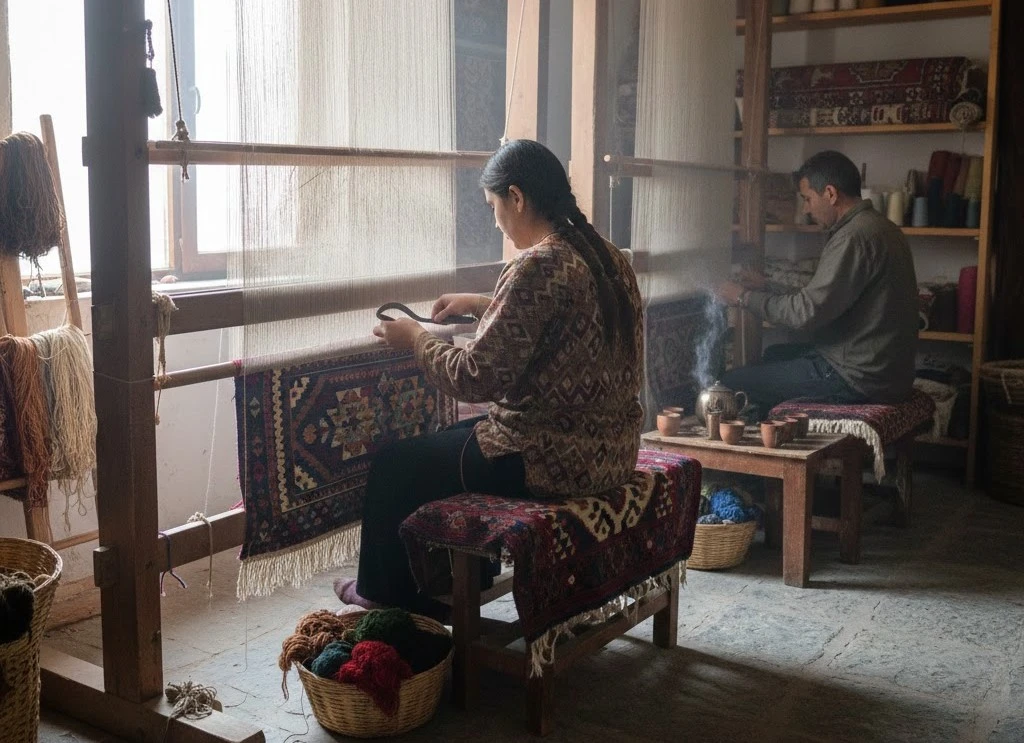
Thousands sometimes millions of knots are tied row by row, guided by memory, pattern charts, and rhythm. For weeks or months, the carpet looks incomplete, even chaotic. The clarity arrives only when the weaving ends and the surface is cut and finished.
Each knot in a hand knotted carpet is tied individually. Wool or silk yarn is looped
around the warp threads, tightened, cut and repeated endlessly. The work is physically demanding and mentally quiet. There is no instant validation. No daily sense of completion. The artisan must trust that every correct knot, though invisible in isolation, will eventually contribute to a coherent whole.
This process trains a very specific temperament. Impatience has no place here. Rushing leads to uneven tension. Carelessness distorts the pattern. The body learns endurance, and the mind learns faith faith that effort invested today will make sense much later. The carpet grows slowly, almost invisibly. Progress is measured not by visible beauty but by consistency. This makes hand-knotted carpet weaving one of the rare crafts where belief precedes reward.
Here, patience is not optional. Patience is infrastructure.
Historically, these carpets were not everyday conveniences. They were created for spaces that demanded grounding homes, prayer areas, communal halls. Their density was not indulgence; it was intention. A carpet thick enough to last decades had to carry immense labour within it. That labour gave the
object weight, both physical and cultural. Modern systems often reduce carpets to décor or comfort. Hand knotted carpets resist this reduction.
They carry within them months of unseen effort.
They remind us that some things are not meant to reveal themselves immediately. Modern life conditions us to expect instant results.
The hand-knotted carpet quietly challenges this mindset. It asks: can you continue working when the outcome is still unclear?
The deeper philosophy of hand knotted carpets lies in delayed meaning. In a world obsessed with previews, metrics, and instant feedback,
this craft stands as a lesson in long faith. Not all work rewards quickly. Not all value is visible during creation.At Svamart, Material Matters draws from this intelligence. Hand knotted carpets show that sustainability is not only about materials, but about mindset.
When systems are built to tolerate waiting, skill survives. When effort is allowed to mature, quality becomes inevitable.
Hand knotted carpets were never about comfort alone. They were about believing in the unseen And that lesson may be one of the most necessary
ones today.
Tools: Vertical looms, detailed design graphs (talim), knotting knives, heavy beaters
Steps logic: In Bhadohi, carpets are large and export-oriented. Designs are complex and often not visible until completion.
This requires structured design charts and tight loom setups. The process is linear and long, built to handle months of continuous work.
Why this process: Because scale is high and timelines are long, the system trains faith and endurance. Tools priorities consistency over flexibility.
Tools: Medium-sized looms, standardised knotting tools, repetitive pattern guides
Steps logic: Mirzapur focuses on uniformity and technique. The weaving steps are highly repetitive with minimal variation. Patterns repeat in controlled cycles, reducing error margins.
Why this process:
The region values technical mastery. Tools and steps are designed to turn repetition into skill, not fatigue.
Tools: Smaller looms, natural fibre yarns, simple hand tools
Steps logic: Varanasi carpets are woven in shorter cycles. Designs are symbolic rather than dense. Steps allow frequent pauses, as weaving coexists with ritual life.
Why this process: Because carpets are meant for grounding and prayer, the process prioritises attentiveness over output.
Tools: Horizontal or adjustable looms, thicker yarns, repair-friendly knots
Steps logic: Weaving here is straightforward. Designs are simple, knot density moderate. Steps allow easy correction and long-term repair.
Why this process: Carpets are for daily community use, so tools and steps support durability and maintenance, not perfection.
Tools: Portable looms, basic hand tools, minimal mechanisation
Steps logic: Weaving is integrated into domestic life. Steps are flexible, allowing work to pause and resume. No strict timelines.
Why this process: Because the system supports livelihood with dignity, not industrial output. Tools serve people, not schedules.
These differences exist because each region answered a different question: how to wait, how to repeat, how to ground, how to endure. Together, they form a carpet culture that values time, trust, and continuity over speed or spectacle.
Hand knotted carpets reveal a deeper philosophy of patience and belief. This blog explores their process, history, and why meaning appears
only at the end.
You need to Sign in to view this feature
This address will be removed from this list