
Your cart is empty, and it looks like you haven’t added anything yet.
Childhood is fleeting, delicate, and profoundly formative. Neuroscience tells us that 85% of a child’s brain develops before the age of six. Every touch, every sound, every story they encounter influences not only their cognitive growth but their emotional intelligence, creativity, and identity. And yet, in a world dominated by plastic, flashing lights, and pre-programmed toys, the essence of meaningful play is quietly slipping away.
“A toy is never just a toy. It is a silent teacher, a first companion, a blueprint for the human mind.”
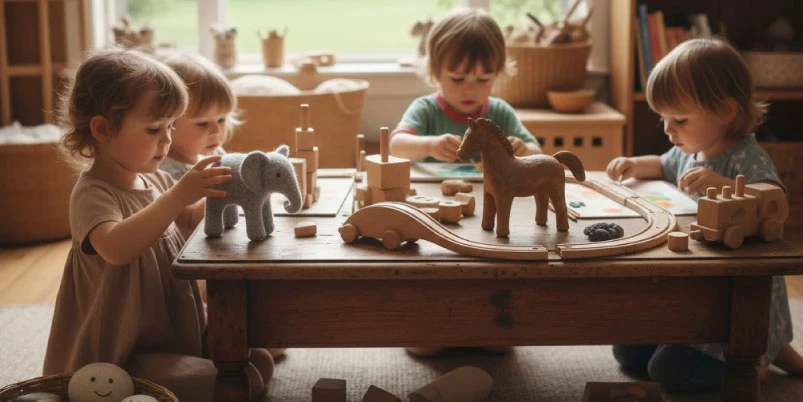
Handmade toys are far more than simple playthings. They are conduits of learning, empathy, and cultural continuity. Unlike battery-operated toys that act for the child, handmade toys demand participation. A woolen elephant, a clay horse, or a stitched doll becomes alive only when the child breathes their imagination into it. This open-ended interaction fosters problem-solving, independent thinking, and creativity. Toys that perform all the work stunt imagination; toys that wait for the child to act cultivate it.
Point to pause: Studies show children who engage in open-ended play score higher in problem-solving tests and exhibit stronger emotional regulation.
Natural materials carry meaning. Wood, clay, wool, and cotton communicate information to the senses that screens and plastic cannot. The weight of a wooden block, the texture of wool, the pliability of clay all stimulate the brain in subtle, profound ways. This is sensory intelligence in action: hands learning to negotiate the real world while the brain forms connections for life. Without it, a child may grow with knowledge but lack the capacity to experience, feel, and interact meaningfully with the world.
“Children don’t just play with toys. They learn how to exist in the world through them.”
Emotional attachment is equally critical. Handmade toys, imbued with the warmth of human hands, teach comfort, patience, and empathy. A child can speak their fears, joys, and dreams to a simple cloth doll, something a plastic toy can never mirror. The over-stimulating, flashy toys of mass production may momentarily entertain, but they fail to foster emotional resilience. Handmade toys, in contrast, cultivate the kind of inner security that allows children to navigate relationships and society with empathy.
“A handmade toy teaches a child how to feel, not just how to play.”
Culture, too, finds its first expression in toys. A clay figurine, a spinning wooden top, a woven animal each carries the stories of generations. These toys give children a sense of belonging, an early introduction to identity, and a framework for understanding their roots. When a child plays with a culturally grounded toy, they are simultaneously holding history, art, and heritage in their hands.
Point to pause: Early exposure to culturally meaningful objects enhances children’s appreciation for diversity and instills lifelong respect for tradition.
Safety cannot be overlooked. Plastics often contain harmful chemicals like BPA and phthalates, which children explore orally and through skin contact. Handmade toys crafted from natural materials are safe, non-toxic, and eco-friendly. Choosing these toys means giving children a safe start while teaching them respect for nature.
“The hands that hold a toy today shape the conscience of the adult tomorrow.”
The consequences of ignoring these truths are subtle yet profound. Children surrounded by artificial, soulless toys risk diminished attention spans, stunted imagination, and a fragile connection to culture and nature. In contrast, those who grow up with thoughtful, handmade toys are likely to become imaginative thinkers, emotionally aware individuals, and culturally grounded citizens.
Handmade toys are not a luxury. They are an investment in human potential, an intersection of art, science, and responsibility. Every stitch, every carved detail, every hand-kneaded shape represents an opportunity for a child to learn, feel, and grow. Choosing wisely today is a call to action: to parents, to educators, to anyone who cares about the future. The objects we place in a child’s hands now will echo across the decades of their lives.
“Give children toys that teach them how to be human, not just how to occupy time.”
You need to Sign in to view this feature
This address will be removed from this list