
Culture

Before Sustainability Had a Name, This Art Already Practiced It

By Deepak Pal 28 Views Dec 19, 2025
Before Sustainability Had a Name, This Art Already Practiced It

When Stories Were Carried, Not Consumed

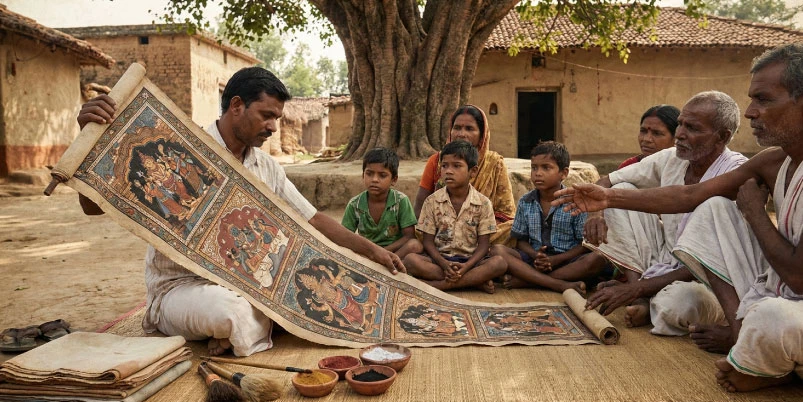
There was a time when stories were not stored or scrolled through. They were carried from one hand to another, from one generation to the next. Long before books entered homes and screens entered lives, stories lived through memory, voice, and line. Pattachitra emerged from that world, not as decoration, but as a system of transmission where meaning mattered more than display.

A patua does not begin by choosing a subject. The story already exists. What begins is preparation strengthening the cloth, mixing natural colours, and readying the hand. The brush touches the surface without hesitation, guided by repetition, memory, and belief. These lines do not search for form. They remember it.

Some lines are not drawn. They are inherited. Pattachitra was never meant to be silent art. It was shown, sung, and explained. These paintings carried epics, folklore, moral questions, and social memory to communities that did not rely on written texts. This was storytelling before literacy and design before printing. Art here was not an object to admire from a distance. It was a responsibility shared between the artist and the viewer.

Material Was Never Just a Medium

Material choice shaped everything. Handmade cloth, palm leaves, and pigments derived from earth and stone defined the pace and discipline of the process. Nothing was excessive, and nothing was permanent. The art accepted decay as part of its truth.

An art form that returns to the earth does not fear time.

What makes Pattachitra deeply relevant today is not its age, but its understanding of limits. Limited materials created focus. Limited colours trained observation. Repeated themes strengthened imagination. Constraint did not restrict creativity; it refined it.

When material is limited, meaning deepens.

This art cannot exist without human skill. Every line depends on muscle memory, lived understanding, and cultural context. There are no shortcuts, templates, or machines that can replace this intelligence. Skill here is not an accessory; it is the foundation.

Remove the hand, and the story collapses.

What Pattachitra Teaches Modern Sustainability

Modern systems prioritise speed, scale, and replication. Processes are designed to reduce dependence on people, and this is celebrated as efficiency. Pattachitra quietly challenges this logic by asking a difficult question: what happens to meaning when skill becomes optional?

Efficiency replaces effort. It cannot replace understanding.

Sustainability in Pattachitra is not a goal; it is a consequence. Colours return to the soil, stories return to society, and knowledge returns to the next generation. Nothing is extracted beyond what can be replenished. Nothing is exhausted for short-term gain.

This art survives because it takes only what it can give back.

At Svamart, the philosophy of Material Matters is deeply informed by traditions like Pattachitra. When material is respected, systems slow down. When systems slow down, skill finds space. When skill finds space, continuity becomes possible. This is sustainability not as a claim, but as a lived structure. Pattachitra is not relevant because it looks beautiful. It is relevant because it shows another way of building systems where progress does not mean erasure, innovation does not mean replacement, and sustainability is embedded at the beginning rather than added at the end.

Before sustainability had a name, this art was already practicing it.

Perhaps the future does not need more invention. Perhaps it needs remembrance. That materials speak, that hands carry intelligence, and that stories last longer when they are carried rather than consumed. Some lines do not fade. They wait. And as long as they are remembered, sustainability remains not an aspiration, but a way of living.

Share Now

Download application to explore more

Bringing art into lifestyle