
Welcome offer: 10% off on your first order with code "SVAMART10" X
Svamart Crafting Lifestyl...

4,000 Years, One Mould, Zero Copies: The Untold Power of Dhokra Art

By Deepak Chandra 7 Views Jun 20, 2026
4,000 Years, One Mould, Zero Copies: The Untold Power of Dhokra Art


Somewhere in the tribal belts of Chhattisgarh, Odisha, West Bengal, and Jharkhand, an artisan is melting a thin layer of wax over a clay core, exactly the way someone in the Indus Valley Civilisation once did, roughly 4,000 years ago. The technique has barely changed. The tools are still simple: clay, beeswax, resin, cow dung, and fire. And yet, the result is something modern manufacturing with all its precision machinery still cannot replicate: a piece of metal art that is, quite literally, one of one.

This is Dhokra art, and it carries within it not just a craft technique, but a philosophy. A philosophy about impermanence, about imperfection as beauty, and about a way of making things that has nothing to do with speed or scale. To understand Dhokra is to understand a different relationship with objects altogether one where the "flaw" is the proof of authenticity, not a defect to be corrected.

A Craft That Outlived Empires

Dhokra's story begins long before recorded history as we know it. Its origins are traced back to the Indus Valley Civilization, approximately 4,000–4,500 years ago, where the famous 'Dancing Girl' bronze statue from Mohenjo-daro is the oldest known example created using this method. Think about what that means: the small bronze figure of a girl, standing with her hand on her hip, confident and unhurried, was made using the same fundamental process that tribal artisans in Bastar use today to cast a Ganesha or a tribal drummer.

The name 'Dhokra' comes from the Dhokra Damar tribe, who were nomadic metalworkers and have preserved this art form through generations. Primarily practiced by tribal communities such as the Gadwa in Bastar, the Ojha in Adilabad, and the Karmakar in Bankura, this craft remains prevalent across Bastar, West Bengal, Odisha, Jharkhand, and Telangana. What started as the work of wandering metalsmiths, moving from village to village, has become one of India's most recognisable tribal art forms still made almost entirely by hand, still passed down within families rather than taught in institutions.

Interestingly, this wasn't a uniquely Indian invention either. The lost-wax casting technique was once practised by civilisations as diverse as ancient Egypt, Mesopotamia, Greece, and China, but in India it has become inseparably linked with the nomadic Dhokra tribe, who carried it forward across millennia while other civilisations largely moved on to industrial methods.

The Philosophy Hidden in the Process

What makes Dhokra genuinely different from almost every other form of craft handmade or otherwise is something most buyers don't realise until they understand the process itself.

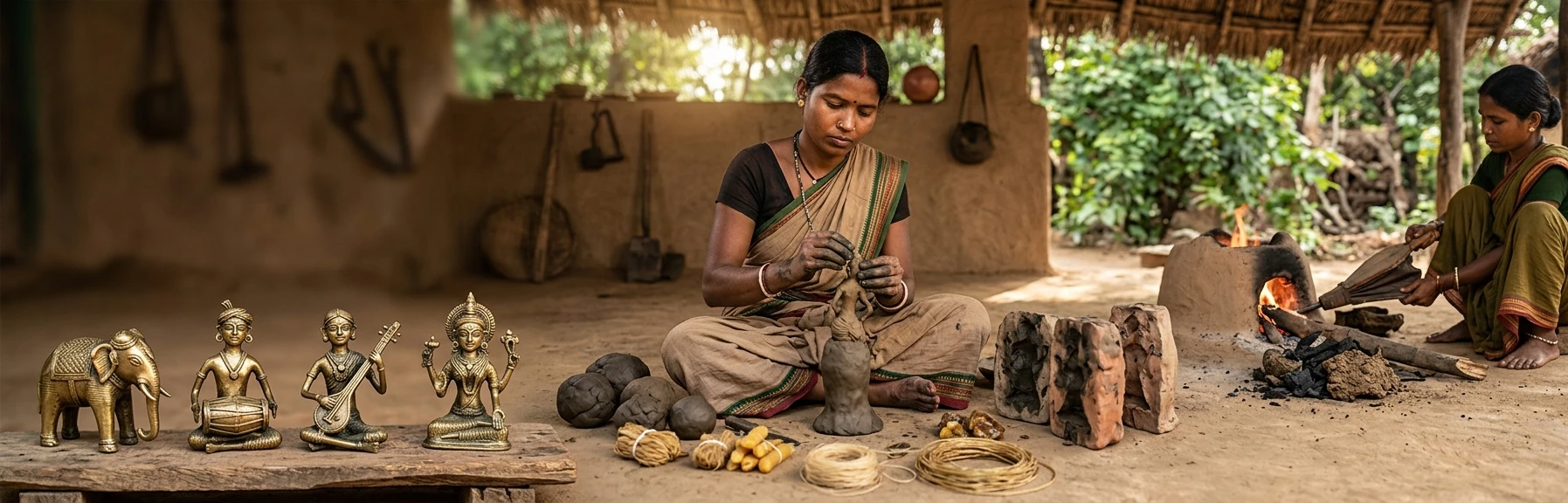
A Dhokra piece begins as a core of clay, shaped roughly into the final form. Over this, the artisan builds up a layer of wax, often using thin threads of beeswax mixed with resin, meticulously detailing the figure the folds of a drummer's clothing, the curve of a deity's arm, the texture of an animal's mane. A second layer of clay then covers this wax model entirely, encasing it completely. The mould is then heated. The wax melts and drains away, leaving a hollow cavity in the exact shape the artisan had sculpted. Molten brass or bronze is poured into this cavity. Once it cools, the outer clay shell is broken open to reveal the metal piece inside.

And here is the part that carries real philosophical weight: the mould is destroyed in the process. There is no way to make a second, identical piece from it. If an artisan wants to create another version of the same figure, they must build an entirely new wax model, by hand, from scratch. No two Dhokra pieces not even ones made by the same artisan depicting the same subject will ever be perfectly identical.

In a world increasingly defined by mass production, infinite duplication, and perfect machine-made symmetry, Dhokra stands as a quiet rebellion. Each piece is not a copy of an idea it is the idea, made once, and never again exactly the same way.

What Dhokra Figures Actually Represent

Dhokra art was never created merely for decoration. Traditionally, it served a far more rooted purpose religious, social, and deeply tied to tribal life. Artisans first sculpt a clay core, which is then covered with wax to form the intricate details, after which another layer of clay encases the wax model before it is heated to allow the wax to melt away, leaving a hollow mould; molten metal is then poured in, solidifying into the final piece once cooled.

The subjects chosen by Dhokra artisans tell their own story. This art form gives life to figurines of horses, drummers, tribal deities, and decorative plaques each one rooted in the daily rhythms and beliefs of tribal communities. Musicians playing string instruments, women carrying water, bulls and elephants, and deities worshipped by forest-dwelling communities were not chosen arbitrarily. They were depictions of life as it was actually lived agricultural, communal, spiritually intertwined with nature.

Historically, Dhokra artists travelled from village to village, selling their exquisite artefacts of Hindu deities in exchange for food a detail that reveals just how deeply this craft was woven into the rural economy and spiritual life of the regions it came from. It wasn't art made for galleries. It was art made for households, for shrines, for everyday devotion.

The Hands That Still Carry This Forward

Despite centuries of change colonisation, industrialisation, the arrival of cheap factory-made alternatives Dhokra has survived because specific tribal communities chose, generation after generation, not to let it die. Tribes like the Dhokra Damar of West Bengal, the Gonds of Betul in Madhya Pradesh, and the Gadaba of Odisha continue keeping the art alive, despite challenges such as rising material costs and competition from mass production.

This is perhaps the most important thing to understand about a Dhokra piece sitting in your home: it isn't simply "ethnic decor." It's the product of a livelihood, sustained against considerable economic pressure, by communities for whom this craft is not a side hustle but an inherited identity. The livelihoods of tribes like the Gonds, Sithulias, Jharas, and Ghadwas depend directly on the intricate work this craft demands.

Why Dhokra Still Matters in a Mass-Produced World

It would be easy to dismiss Dhokra as simply "rustic" or "antique-looking" home decor. But sit with the process for a moment longer, and a different idea emerges one that feels almost countercultural today.

We live in an age that prizes speed, scale, and reproducibility. A product's success is often measured by how quickly and cheaply it can be made identically, a thousand times over. Dhokra inverts every part of that logic. It is slow. It cannot be scaled without losing its essence. It cannot be made identical, even on purpose. Every irregularity a slightly uneven surface, a tiny asymmetry in a figure's pose isn't a flaw to be corrected in the next batch. There is no next batch. There is only this piece, made this one time, by this one person's hands. In that sense, owning a Dhokra piece is less like owning a "product" and more like owning a moment one specific afternoon when an artisan sat with clay, wax, and fire, and made something that will never exist in quite the same way again.

Dhokra Pieces Worth Bringing Home

Reading about the philosophy behind Dhokra is one thing seeing how it actually translates into objects you can hold is another. Here are a few standout pieces that capture the range of what this craft creates, from devotional figures to everyday decorative accents.

Deities and devotional pieces remain at the heart of Dhokra's tradition. The Handcrafted Dhokra Brass Radha Krishna Figurine with Bansuri captures one of Indian mythology's most tender moments Krishna playing the flute beside Radha rendered in the same rustic, textured brass finish that has defined this craft for millennia. For a more solitary devotional piece, the Dhokra Craft Home Decor – Shri Krishna Playing Bansuri offers the same theme in a simpler, single-figure form, while the Dhokra Handicrafted Lord Jagannatha Idol brings the distinctive, stylised form of Jagannath worshipped widely in Odisha, the very region where much of this craft survives today.

Tribal life and folk figures are where Dhokra's storytelling tradition really comes alive. The Dhokra Art of a Tribal Lady Reading a Book in Sleeping Posture and the Dhokra Craft Depicting a Tribal Woman Seated on a Cot with Mirror and Comb are quiet, everyday scenes exactly the kind of domestic moments Dhokra artisans have immortalised for generations. The Dhokra Crafted Tribal Musician Figurine captures another recurring theme in this art form: music as a thread running through tribal community life.

Animal figures, often symbolic of strength, wisdom, or grace, are among Dhokra's most popular subjects. The Dhokra Crafted Elephant, the Dhokra Crafted Horse, and the Dhokra Crafted Tortoise each carry their own quiet symbolism in Indian tradition the elephant for strength and good fortune, the horse for momentum and power, the tortoise for patience and steadiness.

Functional and decorative objects show how Dhokra has adapted beyond pure figurines. The Handcrafted Dhokra Brass Mana Bowl is a traditional decorative vessel, while the Handcrafted Dhokra Brass Lantern brings the craft's signature rustic texture into a piece that doubles as ambient home lighting. For everyday devotional use, the Dhokra Puja Hand Bell is a small but meaningful way to bring this 4,000-year-old technique into daily ritual.

You can browse the complete collection on the Dhokra Art category page, where every piece carries the same promise: handmade, one at a time, and never quite repeatable.

Why Dhokra Makes a Standout Corporate Gift

Corporate gifting has a familiar problem: most gifts feel interchangeable a branded diary, a generic hamper, something that gets forgotten by the following week. Dhokra solves this problem in a way few other categories can.

Because no two Dhokra pieces are ever truly identical, every recipient receives something that genuinely cannot be replicated, even within the same order. That alone makes it a far more memorable choice than mass-produced corporate merchandise. It also carries a built-in story 4,000 years of unbroken tribal craftsmanship which gives the gift meaning beyond the object itself, something a sales team, a client, or a senior leadership group can immediately appreciate without needing it explained at length.

Practically speaking, Dhokra also works well at scale. Smaller pieces like the Dhokra Crafted Tribal Musician Figurine or the Dhokra Puja Hand Bell sit comfortably within typical corporate gifting budgets, while statement pieces like the Handcrafted Dhokra Brass Lantern or the Dhokra Handicrafted Lord Jagannatha Idol work well as premium gifts for senior stakeholders, retiring employees, or long-standing clients. And because each piece directly supports tribal artisan communities, gifting Dhokra also lets a brand quietly signal its values sustainability, authenticity, and support for India's craft heritage without saying any of that out loud.

For businesses exploring bulk or customised options, Svamart's Corporate Gifting page is worth a look Dhokra pieces are exactly the kind of gift that gets kept on a desk, not left in a drawer.

Caring for a Dhokra Piece

  1. Dust regularly with a soft, dry cloth to prevent buildup in the textured detailing.
  2. Avoid harsh metal polishes, which can strip away the deliberately rustic, antique patina that gives Dhokra its character.
  3. Keep away from prolonged moisture, as this can affect the natural oxidised finish over time.
  4. Display thoughtfully a single Dhokra figure often makes a stronger visual statement than several crowded together, allowing its details to be genuinely appreciated.

Conclusion

Dhokra art is, in many ways, a 4,000-year-old argument against everything modern manufacturing stands for and it has been winning that argument quietly, in tribal workshops, for longer than most civilisations have existed. It asks nothing of the buyer except an appreciation for the fact that something was made slowly, by hand, and will never be made in exactly that way again.

To bring a Dhokra piece into your home is to hold onto a small fragment of that 4,000-year continuity a craft that has outlasted empires, survived industrialisation, and still, today, depends on the steady hands of tribal artisans who learned it the same way their ancestors did: not from a textbook, but from watching, and doing, and passing it on.

Share Now

Discover authentic handmade treasures.

Shop consciously. Live consciously.