
Your cart is empty, and it looks like you haven’t added anything yet.
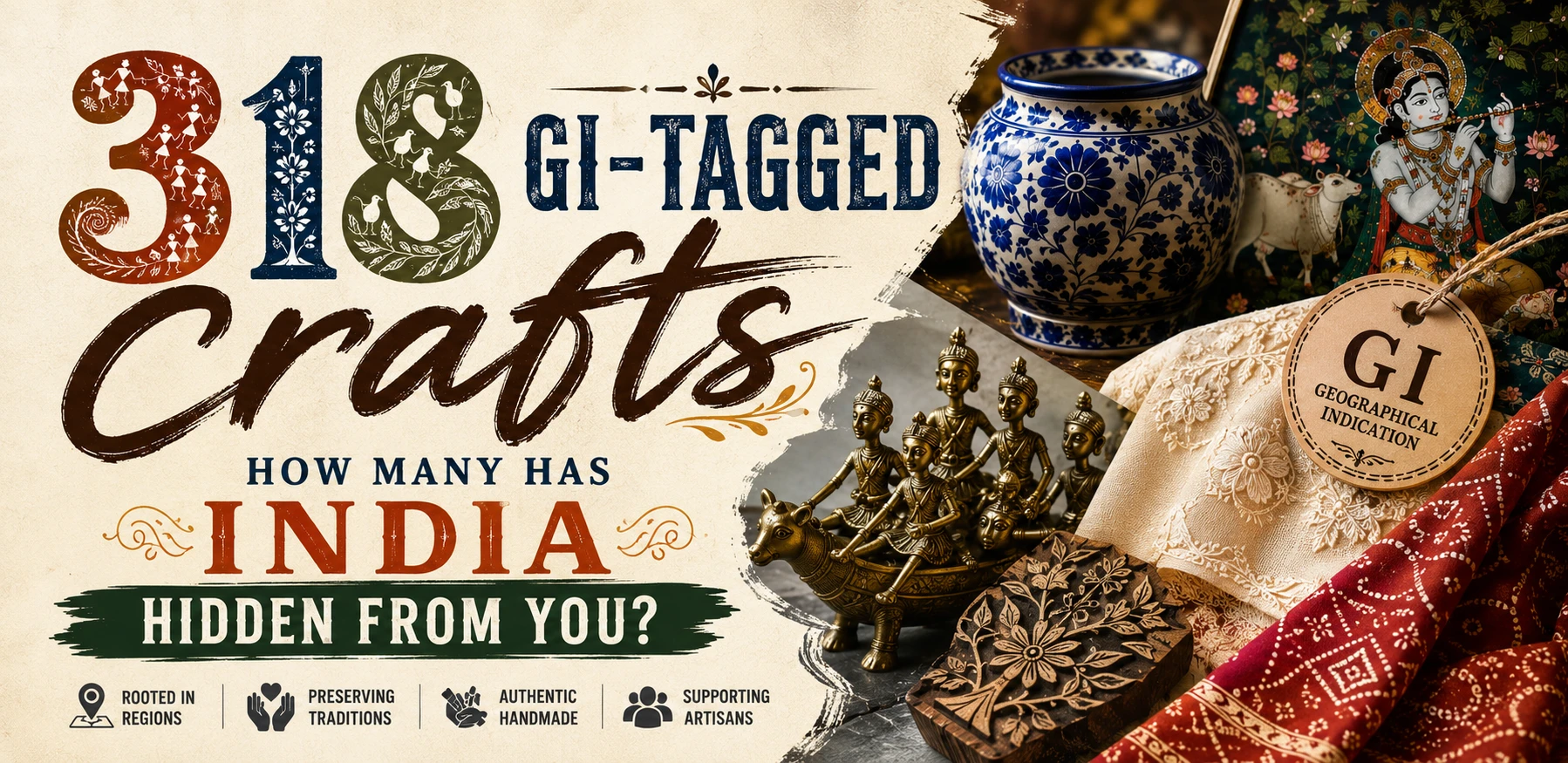
India is often called a land of a thousand crafts, but the actual number is far more staggering than most people realise. As of today, India is home to 318 GI-tagged handicraft products, spread across nearly 455 distinct craft categories. That means there are hundreds of regional art forms, weaves, sculptures, and traditional techniques quietly thriving in villages and towns across the country many of which have never made it into mainstream conversation.
For most shoppers, the names that come to mind when they think of Indian handicrafts are limited to a handful of well-known ones: Banarasi silk, Madhubani paintings, or perhaps Blue Pottery. But behind these familiar names lies an enormous, largely undiscovered universe of crafts, each with its own story, technique, and regional identity. In this article, we take a closer look at what a GI tag actually means, why it matters, and some of the lesser-known crafts that deserve a place in your home.
GI stands for Geographical Indication. In simple terms, a GI tag is an official certification that links a product to a specific geographical region, recognising that the product's qualities, reputation, or characteristics are essentially attributable to its place of origin.
Think of it as a stamp of authenticity. When a craft receives a GI tag, it means that only producers from that specific region, using traditional methods, are legally allowed to market their product under that name. For example, only sarees woven in and around Banaras using traditional techniques can be sold as "Banarasi silk" with a GI certification.
For consumers, a GI tag offers a layer of assurance. It tells you that the product you are buying is not a mass-produced imitation but an authentic piece created using techniques passed down through generations within a specific community. This is particularly important in a market where imitation products often machine-made and sold at lower prices can sometimes be passed off as "handmade" or "traditional." When you purchase a GI-tagged product, you are also indirectly supporting the artisan community associated with that craft, helping preserve traditional knowledge that might otherwise be lost to industrialization.
With 318 GI-tagged handicraft products spanning nearly 455 craft categories, India's craft landscape is one of the most diverse in the world. This diversity exists because almost every state, and often every district within a state, has developed its own distinct craft traditions over centuries shaped by locally available materials, climate, religious practices, and cultural influences.
This is why two regions located just a few hundred kilometres apart can have completely different craft identities. A craft from Rajasthan might rely on stone, mirror work, or block printing, while a craft from West Bengal might focus on terracotta, jute, or kantha embroidery. Each tradition is a product of its unique environment and history.
While Banarasi silk and Madhubani paintings have achieved national and international recognition, they represent only a small fraction of India's GI-tagged crafts. Here are some lesser-known crafts that showcase the depth of this diversity.
Originating from the Warli tribal community of Maharashtra, this art form uses simple geometric shapes circles, triangles, and lines to depict scenes from daily life, nature, and rituals. Traditionally painted on mud walls using rice paste, Warli art has now found its way onto canvases, home decor items, and fabrics.
Pichwai paintings are intricate, devotional artworks traditionally created as backdrops for deity idols in temples, particularly associated with Lord Krishna. These paintings are known for their elaborate detailing, vibrant colours, and depictions of nature, festivals, and mythological scenes.
Dhokra is one of the oldest known metal casting techniques, using the lost-wax casting method. Artisans from states like Chhattisgarh, Odisha, and West Bengal create tribal-style figurines, sculptures, and decorative items using this ancient process, often depicting musicians, animals, and folk deities.
Lippan art, also known as mud mirror work, originates from the Kutch region of Gujarat. It involves creating relief patterns using a mixture of mud and clay, which is then embedded with small mirror pieces. The result is a striking, reflective surface often used for wall decor and traditional home interiors.
Aipan is a traditional folk art form from the Kumaon region of Uttarakhand, characterised by geometric and ritualistic patterns drawn using a paste made from rice flour on a red ochre base. Traditionally used during festivals and ceremonies, Aipan designs have now been adapted for home decor and stationery items.
While more widely known than some of the other crafts on this list, Chikankari embroidery from Lucknow deserves a mention for its sheer intricacy. This delicate, white-thread embroidery technique involves dozens of stitch variations and is traditionally done on fine cotton or muslin fabric.
Despite its name, Blue Pottery does not actually use clay in its traditional form it is made from a unique dough made of quartz powder, multani mitti (Fuller's earth), and other natural materials. The vibrant blue glaze, derived from cobalt oxide, gives this pottery its distinctive look, commonly seen in vases, tiles, and decorative items.
With the growing popularity of "ethnic" and "handmade" decor, the market has also seen a rise in machine-made products that mimic traditional designs. Here are a few practical tips to help you identify genuine handcrafted, GI-associated products:
To truly appreciate the scale of India's craft heritage, it helps to think of it region by region:
This is just a glimpse each of these states is home to multiple other GI-tagged crafts beyond what is listed here.
India's craft heritage is far richer and more layered than most people realise. With 318 GI-tagged products spread across 455 craft categories, the country holds a vast repository of traditional knowledge, regional identity, and artisan skill much of which remains unexplored by the average shopper.
Choosing GI-tagged or authentically handmade products is not just about decorating your home with something unique. It is about engaging with a piece of living history, supporting the communities that have preserved these crafts for generations, and ensuring that this incredible diversity continues to thrive for generations to come. The next time you shop for home decor or gifts, take a moment to look beyond the familiar names you might just discover a craft tradition you never knew existed.
You need to Sign in to view this feature
This address will be removed from this list